

Rethinking River Health Monitoring in Cities: Assessing Urban Waste Impacts

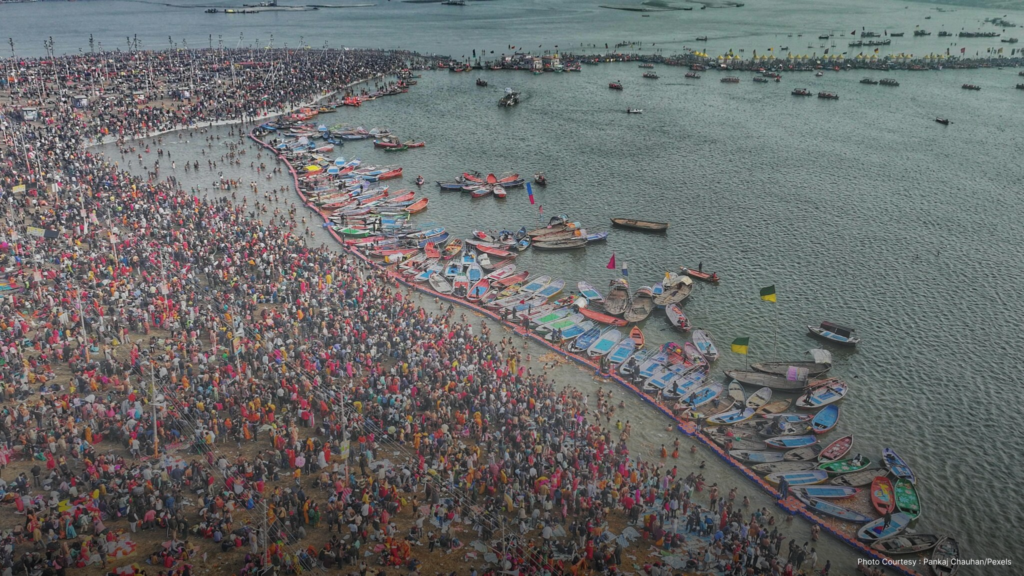
Rivers in India hold immense social, economic, and cultural significance. They are sources of water for drinking, irrigation, industrial use, and hydropower generation. They also support aquatic ecosystems and employment- generating industries such as fisheries, aquaculture, and tourism. In India, rivers are also worshipped and often serve as centres for religious and spiritual gatherings. The Maha Kumbh Mela, one of the largest religious congregations held every 12 years on the banks of the river Ganga, is an example of the immense cultural significance that rivers have in India.

Kumbh Mela 2025 at Triveni Sangam, Uttar Pradesh     

And yet, major river systems of India are facing ecosystem degradation driven by factors such as urbanisation, industrialisation, pollution, and climate change. Major rivers such as the Ganga and Yamuna continue to experience acute degradation within urban stretches, driven primarily by untreated or partially treated sewage discharge, industrial effluent discharge and inefficient solid waste management systems. As per World Bank estimates, water pollution costs India 3% of its annual GDP due to expenditure on healthcare, a decline in revenues from agriculture, fisheries, and tourism.

The Impact of Urbanisation

Urban centres contribute disproportionate pollution loads relative to river length, whether from municipal solid and liquid waste or industrial effluents, thus making them critical nodes of river pollution. This is corroborated by studies which showed improvement in the water quality of major rivers during COVID-19 lockdown. Rivers like Ganga, Brahmaputra, Godavari, Narmada, and others recorded an increase in their dissolved oxygen concentration and decrease in their biological oxygen demand (BOD) and coliform levels during the lockdown when urban, commercial and industrial activities had been severely restricted (Mahadikar et al., 2022).

Sewage remains the largest contributor of pollution by volume with a significant gap between generation and treatment.

"As per the Central Pollution Control Board (CPCB), India’s urban centres generated approximately 72,368 MLD of sewage in 2021, of which only 28% was treated; the remaining 72% being discharged untreated into rivers, lakes and other water bodies."

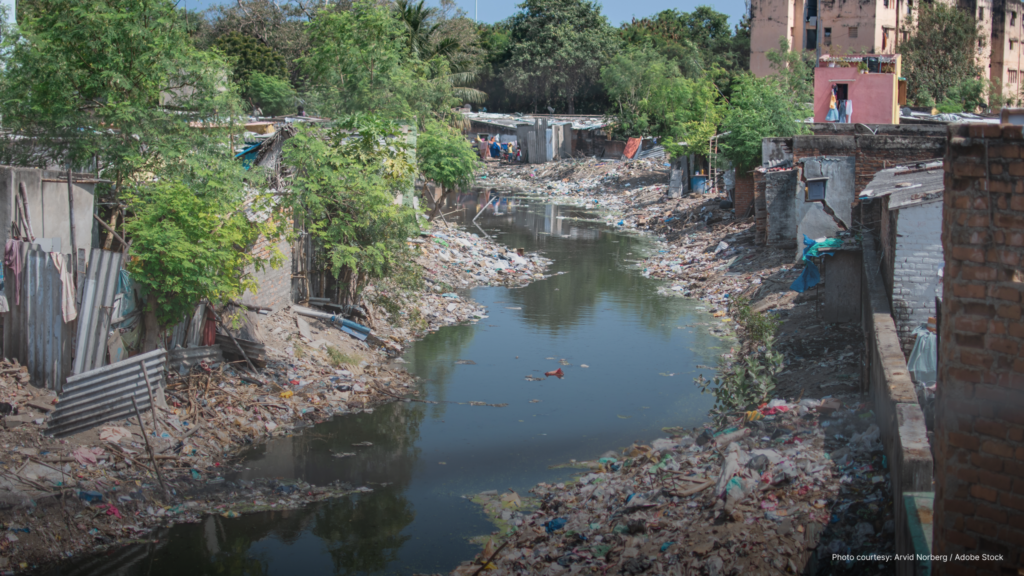
Industrial effluents, while smaller in quantity, introduce high levels of toxicity. There are over 2,800 Grossly Polluting Industries (GPIs) discharging over 400 MLD of treated/partially treated/untreated effluents into various rivers (Source: CPCB, CSE).Inefficient solid waste collection and segregation practices lead to open dumping of solid waste onto streets, riverbanks and urban drains. During monsoon, these drains end up functioning as pollution conduits by carrying rainwater laden with mud, silt and municipal waste from streets and open dumping sites to rivers. This affects aquatic health with microplastics as an emerging threat. Leachate containing heavy metals and organic pollutants from landfills and open waste sites seep into the groundwater or flow into the drains feeding into the rivers.

Plastic waste disposal in a river in the slums of Chennai, Tamil Nadu 

"As monitored under the National Water Quality Monitoring Programme (NWMP), across 271 rivers in 28 States and 3 Union Territories, 296 polluted river stretches were reported in 2025. In these stretches, BOD levels were reported to be above 3 mg/L as required for the water to be deemed fit for outdoor bathing. 25 stretches are in critical category with BOD levels > 30 mg/L."

Several government initiatives such as the Namami Gange Programme and National River Conservation Plans, policies and standards by CPCB and NGT exist to address river pollution. Despite that and large-scale investments in river rejuvenation and sanitation infrastructure, key systemic gaps remain –

a. Water quality monitoring is river-centric, not city-centric

Something that the current river quality monitoring framework misses is to measure the net impact of a city or urban centre on a river when it flows through it. Polluted river stretches are identified by CPCB’s monitoring stations tracking water quality at fixed locations in the river path in various states. But there is no systematic assessment of city level pollution or pollution levels at upstream vs downstream conditions across cities. Without understanding this, pollution measurement remains diffused, unaccounted, and difficult to address effectively at a system level.

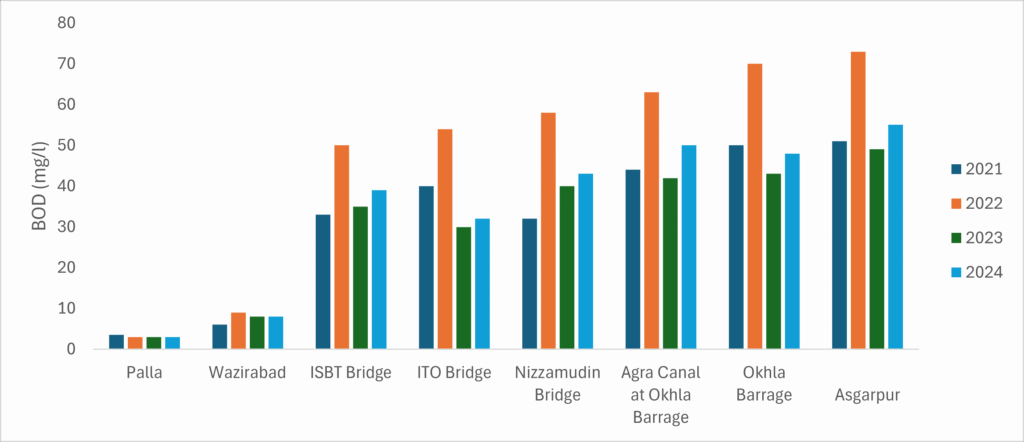
Consider the Yamuna River which enters Delhi at Palla from Haryana and leaves the city at Asgarpur in Uttar Pradesh. In Palla, BOD levels are reported to be near or below the prescribed limit of 3 mg/L. However, as the river exits the city at Asgarpur, BOD levels exceed 50 mg/L, making the 40 km Delhi stretch of Yamuna, one of the most polluted river stretches in the country (DPCC, 2024).

Annual Average Water Quality of Yamuna River
Over its 40 km stretch passing through Delhi, the annual average water quality of Yamuna River progressively worsens from its entry into Delhi at Palla (Haryana) up to its exit at Asgarpur (Uttar Pradesh)

(Source: Department of Environment, Govt. of NCT of Delhi)

b. Weak correlation with urban waste systems

While data exists on sewage and solid waste generation, existing treatment or processing capacity within a city, it is not systematically linked to their effects on river pollution. Particularly, there is very limited assessment linking solid waste management systems to river health. As a result, investments or the lack of it in waste management infrastructure is not linked with environmental outcomes.

c. Fragmented governance

River health lies at the intersection of urban local bodies who are responsible for waste management, pollution control boards who monitor the river health and river basin authorities and government departments. This fragmentation or working in silos provides little scope for accountability of individual institutions in ensuring systems managed by them are performing well.

City Level River Quality Monitoring – A New Approach to Monitoring River Health

At Sankala Foundation, while analysing the aforementioned challenges in river health monitoring, we identified that in order to hold the systems more accountable, it is essential to address a critical missing link in India’s river governance i.e. to assess the impact of urban waste management systems on river health by comparing water quality at entry and exit points of cities across a river pathway. A meaningful approach would be to –

  1. Measure and track river water quality at upstream and downstream stations as a river enters and exits a city. 
  2. Real time measurement should be done with seasonal variations in quality, particularly around monsoon period also to be recorded. 
  3. Real time dashboards tracking this data should be available in offices of urban local bodies, state and central pollution control boards as well as in public domain for awareness of general citizens like how air quality data is reported.
  4. Identify pollution hotspots across sewage, industry, and solid waste through an audit of waste systems.

By introducing upstream–downstream monitoring at city scale, the net pollution added by each city can be quantified and create comparative performance benchmarks. This will allow linking changes in water quality to urban waste systems and enable evidence based action including upgrading/retrofitting existing waste management infrastructure, data driven operation and maintenance and better targeting of investments.

River Health Index/Score

A river health index or score for each city can be calculated by integrating data for water quality, waste audit and performance of existing waste management systems within that city. These scores or index values can also be available on dashboards in public domain. Cities can be incentivised to achieve higher score with financial rewards, performance-linked funding mechanisms and capacity building.

This will help in increasing accountability of urban local bodies, increase citizen engagement and develop targeted, high impact city specific intervention pathways.

Citizen Engagement

Public awareness will need to be enhanced through strategic communication around how their activities are affecting the health of the river within their city. Real time dashboards in public domain displaying water quality parameters of the rivers will allow citizens to be aware of their contribution to river health and hold the institutions as well as themselves accountable. 

Urban local bodies can work with NGOs for behavioural change campaigns to educate citizens about not dumping waste into rivers, connect unsewered colonies to sewer networks or implement decentralised solutions, and incentivise residential societies to install greywater management solutions.

Until we quantify and attribute river pollution to specific waste systems and hold both city level institutions and citizens accountable, our river rejuvenation efforts will continue to fall short.

Author

  • Saurabh Datta supports the research and communication efforts in the Water sector at Sankala Foundation. He holds Master’s degrees in chemistry from IIT Roorkee and chemical engineering from the University of Twente, Netherlands. He has diverse experience in programme management, project implementation, research, engineering, and communication in the environment sector.

    View all posts
Cart (0 items)