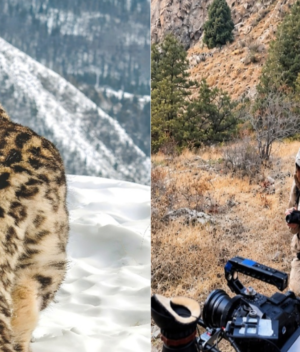
“3 priorities for snow leopard conservation are habitat connectivity and climate resilience, community coexistence, and wild prey recovery with stronger anti-poaching enforcement”- Dr Daria Petrova
Dr Daria Petrova, Director of the Interregional Association Centre for Study and Preservation of Snow Leopard (Irbis) in the Russian Federation
Moving almost unseen across some of the world’s most rugged mountain landscapes, the snow leopard has earned its name as the Ghost of the Mountains. As an elusive apex predator, it plays an important role in maintaining ecological balance, and its conservation is closely linked to the health of these fragile mountain ecosystems.
Yet, these mountains are not just wildlife habitats; they are also home to pastoral communities whose livelihoods and traditions are closely connected to the landscape. While snow leopards may cross national borders, their conservation is often complicated by fragmented habitats, small and isolated populations, and the challenges of monitoring them across remote terrain. In Russia’s Altai–Sayan region, these challenges make scientific research, international cooperation and coexistence with local communities particularly important.
Ms Anjali Lomas interviews Dr Daria Petrova, Director of the Interregional Association Centre for Study and Preservation of Snow Leopard (Irbis), Russia, on snow leopard conservation, transboundary cooperation, and community-led conservation efforts.
AL: Snow leopards cross national borders, including those of Russia, Mongolia, China and Kazakhstan. What are the main challenges and opportunities in coordinating conservation efforts, and how effective has international cooperation been so far?
DP: The Altai-Sayan is an interconnected ecosystem, and snow leopards do not recognise national borders. International cooperation is therefore essential. Russia, Mongolia and Kazakhstan collaborate through joint projects, data sharing, expert exchanges and field expeditions. Russia and Mongolia focus on protecting the Eastern Sayan population to maintain genetic diversity, while Russia and Kazakhstan prioritise safeguarding migration corridors.
Cooperation between Russia and China is still developing. China’s expertise in AI-based monitoring and DNA analysis offers opportunities to strengthen cross-border conservation. In 2025, a conference in Kazan, Russia, brought together experts from all 12 snow leopard range countries for the first time, creating opportunities for further collaboration. The Interregional Association “Irbis” also facilitates international exchanges and joint expeditions, including cooperation between Russian and Mongolian researchers on conserving Altai argali, an important snow leopard prey species.
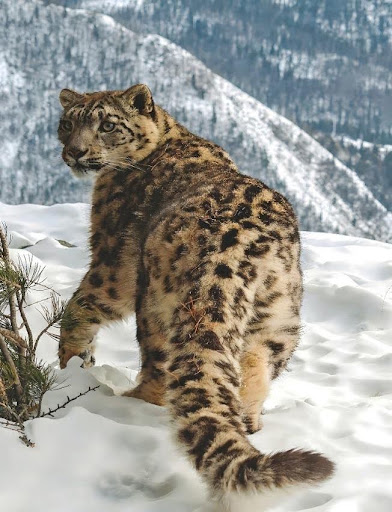
Snow leopard Chara in Sailyugemsky National Park, Russia Photo courtesy Russian Snow Leopard Association Irbis/ Big Cats Magazine (March-April 2026)
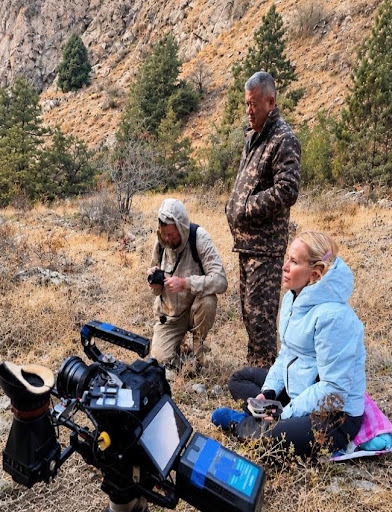
Dr Daria Petrova and team
AL: Given Russia’s small share of the global snow leopard population, what immediate transboundary measures are needed, particularly with China and Mongolia, to maintain habitat connectivity and genetic diversity?
DP: Cooperation with China and Mongolia is essential to maintaining habitat connectivity and gene flow. Along the China–Russia border, snow leopard habitat is limited to the remote Tavan Bogdo-Ula range, including Kanas National Park in China and the Ukok Plateau in Russia. Sharing China’s conservation
“Cooperation with China and Mongolia is essential to maintaining habitat connectivity and gene flow.”
expertise could strengthen Russian monitoring and conservation efforts. The most vulnerable population is in Russia’s Eastern Sayan mountains, where scientists recorded just nine snow leopards, including two cubs, last year, with numbers declining further this year. Isolated from other Russian populations, these snow leopards depend on connectivity with Mongolia for breeding and genetic exchange, while also contributing to the genetic diversity of Mongolian populations. Tunkinsky National Park in Russia and Khuvsgul National Park in Mongolia are vital to protecting these transboundary populations. Strengthening cooperation in law enforcement, monitoring and environmental education is crucial to their long-term survival.
AL: What compensation frameworks and alternative livelihood initiatives could help reduce retaliatory snow leopard killings by pastoral communities in Russia?
DP: In Russia, retaliatory killings are a concern in the Altai and Tyva republics, where traditional pastoral communities depend on livestock for their livelihoods. To address this, the Interregional Association “Irbis” and Sailugem National Park introduced a compensation scheme in Altai in 2021. Herders who promptly report livestock losses can receive monetary compensation after a commission verifies the snow leopard attack.
In Tyva, Ubsunur Hollow Nature Reserve and Tyva Nature Park maintain compensation herds of yaks or sheep, replacing livestock lost to predators. Supported by conservation partners and donors, this approach has helped build trust with herders, encouraging them to refrain from harming snow leopards and report sightings or tracks to conservationists.
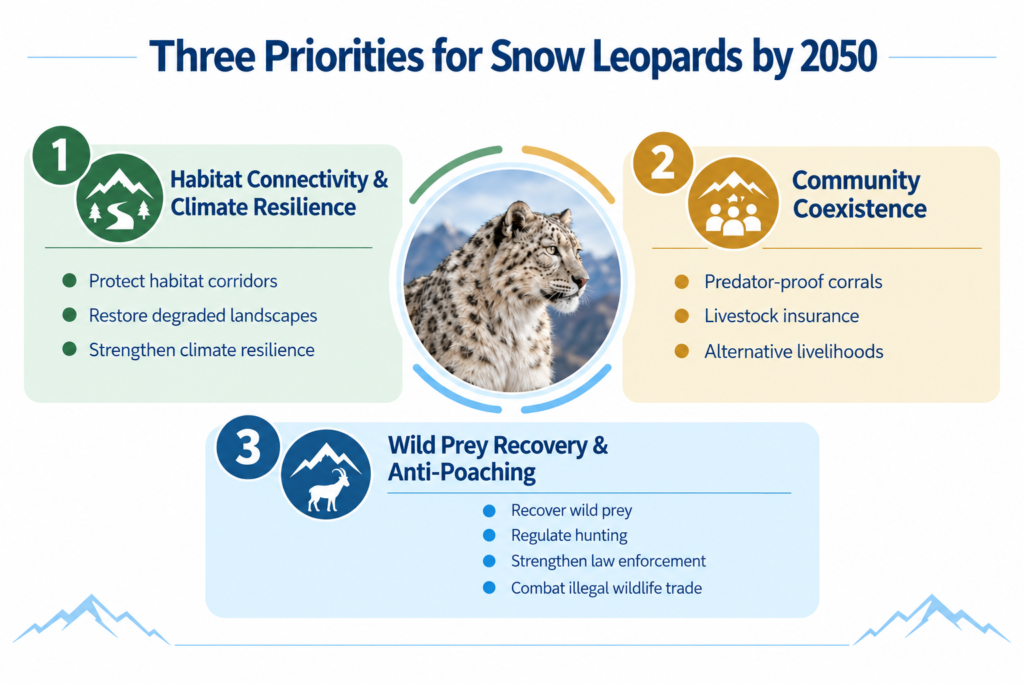
AL: Given your involvement in the Global Snow Leopard and Ecosystem Protection Program (GSLEP), what are your top three priorities for ensuring snow leopards’ long-term survival across all 12 range countries by 2050?
DP: My three priorities are habitat connectivity and climate resilience, community coexistence, and wild prey recovery with stronger anti-poaching enforcement. First, protecting habitat corridors and restoring degraded landscapes will help maintain genetic diversity as climate change, infrastructure and habitat fragmentation increasingly threaten alpine ecosystems.
Second, communities must be central to conservation, supported by predator-proof corrals, livestock insurance and alternative livelihoods such as ecotourism and conservation-linked handicrafts.
Finally, recovering wild prey populations, regulating hunting, reducing competition with livestock and strengthening law enforcement are essential to protecting snow leopards and their prey. International cooperation must also tackle the illegal trade in snow leopard pelts, bones and other body parts to achieve GSLEP’s long-term conservation goals.
Created by Sankala Team
Perspectives on Snow Leopard Conservation in India
AL: Having conducted expeditions in Spiti Valley, how would you assess India’s community-led snow leopard conservation initiatives? Could approaches such as community-based ecotourism be adapted to Russia’s Altai region?
DP: India’s approach to human–wildlife coexistence, particularly in Spiti Valley, is worth studying and replicating. Community involvement, supported by scientific research and environmental education, has helped embed snow leopard conservation within local cultural values. Russia has also developed initiatives, including livestock compensation schemes and the annual “Land of the Snow Leopard” festival in Altai, led by the Interregional Association “Irbis”. Developing ecotourism that allows people to observe snow leopards without disturbing them remains a key aspiration. The Association is working with Russia’s Public Chamber and Ministry of Natural Resources and Ecology to establish a legislative framework for ecotourism in protected areas.
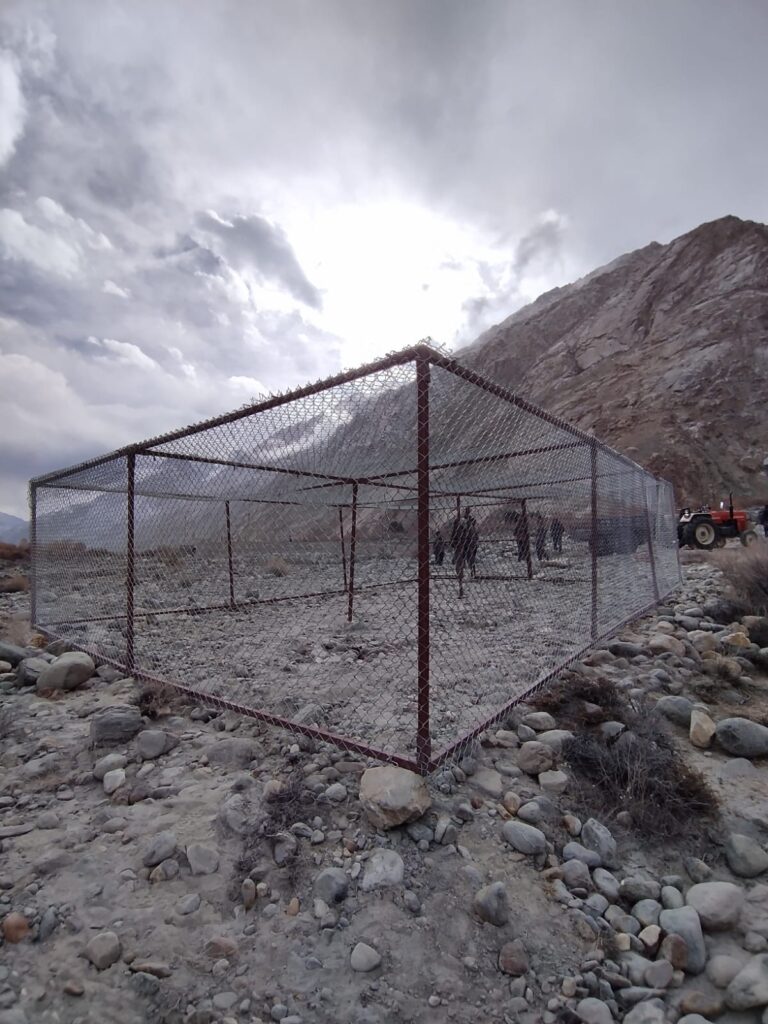
Installation of predator-proof corrals in villages, with active participation from local communities Photo courtesy: Forest Department Ladakh
AL: In India, snow leopards are increasingly reported to tolerate human presence, whereas a long history of hunting has made them more elusive in Russia. How does this affect field research?
DP: Russia is the northernmost of the 12 snow leopard range countries and hosts approximately 2% of the global population. The species is restricted to the rugged mountains of Southern Siberia in the Altai-Sayan ecoregion, where populations are small, fragmented and sometimes isolated. While some Indian habitats support densities of up to 3 snow leopards per 100 km², densities in Russia remain much lower, at around 1 individual per 100 km² even in its most densely populated protected habitats, such as Sayano-Shushensky State Nature Reserve.
“The latest survey recorded a minimum of 94 snow leopards in Russia.”
The scarcity of snow leopards, their low population density, fragmented habitats and the remoteness of areas that are difficult to access and work in significantly influence scientific monitoring methods in Russia. Camera trapping remains the primary method, with cameras checked every 1–3 months, or every six months in remote areas. Image analysis is largely conducted manually, while AI-based systems are under development. DNA analysis has revealed slight genetic differences in the isolated Eastern Sayan population, but sample collection and transport to the only laboratory conducting these studies, in Moscow, remain difficult. GPS tracking is rarely used and has been conducted only once in Sayano-Shushensky Nature Reserve. Russia’s monitoring programme, approved in 2021, combines comprehensive and annual sample-based surveys to assess population size, distribution and threats. The latest survey recorded a minimum of 94 snow leopards in Russia.
A Call for Collective Action
The long-term survival of snow leopards depends on connecting conservation efforts across national borders while recognising the needs of communities that share their habitats. As Dr Petrova’s insights highlight, effective conservation requires reliable population monitoring, protected movement corridors, healthy wild prey populations, and practical support for pastoral livelihoods. Achieving the vision of snow leopard conservation by 2050 will require sustained international cooperation and community-centred approaches that protect both the species and the mountain ecosystems on which it depends.
Dr Daria Petrova, Director of the Interregional Association Centre for Study and Preservation of Snow Leopard (Irbis) in the Russian Federation. With more than nine years of experience in snow leopard research and conservation, Dr Petrova brings valuable insights into population monitoring, transboundary cooperation, and community-based conservation in the Altai-Sayan region. She co-authored Russia’s first nationwide snow leopard assessment in 2025 and has participated in snow leopard expeditions across India’s Spiti Valley, Mongolia’s Gobi Desert and Ubsunur Hollow, and Sailugemsky National Park in Russia’s Altai region. Drawing on these experiences, she discusses the challenges of conserving small and isolated populations, the role of local communities in reducing retaliatory killings, and the importance of maintaining habitat connectivity across national borders.
Anjali Lomas is a Research Associate at Sankala Foundation and holds a master’s degree in Environment and Development from Dr. B.R. Ambedkar University, Delhi. Her work focuses on human–wildlife conflict, biodiversity conservation, community-based environmental management, and environmental policy.