


Sacred Groves: Living Models for Sustainable Conservation

Introduction

There is so much to learn from the conservation model that the Sacred Groves offer, what can centuries-old community institutions teach us about conserving biodiversity, water resources, and building climate resilience? Recent studies and cultural documentation undertaken by the Sankala Foundation about indigenous communities in the North-eastern parts of India, suggest that these landscapes offer significant lessons for contemporary conservation.

According to Wildlife Institute of India, Sacred Groves are pristine patches of vegetation varying in size (ranging from a few trees to hundreds of acres), which are protected by local communities due to deep rooted religious, cultural, and spiritual significance.

Sacred groves sit precisely at the intersection of culture and civilization. Rather than belonging exclusively to one or the other, they represent a phenomenon where cultural values are utilized to build a civilizational survival mechanism with the environment.

The Cultural Dimension: The “Soul” of the Grove

At their point of origin, sacred groves are purely cultural. They are an expression of how early human societies understood their existence not without their natural environment. By designating a patch of forest as the abode of a deity, the community separates it from the “profane” space of everyday exploitation.

They root themselves in primitive religious systems where nature isn’t just a resource, but a living entity possessed of a spirit. Myths, folklore, rituals, and taboos that protect the grove are entirely cultural artifacts. For many indigenous and tribal communities, the grove is the anchor of their social identity. Festivals celebrated within the grove reinforce community solidarity and pass down ancestral knowledge through oral traditions.

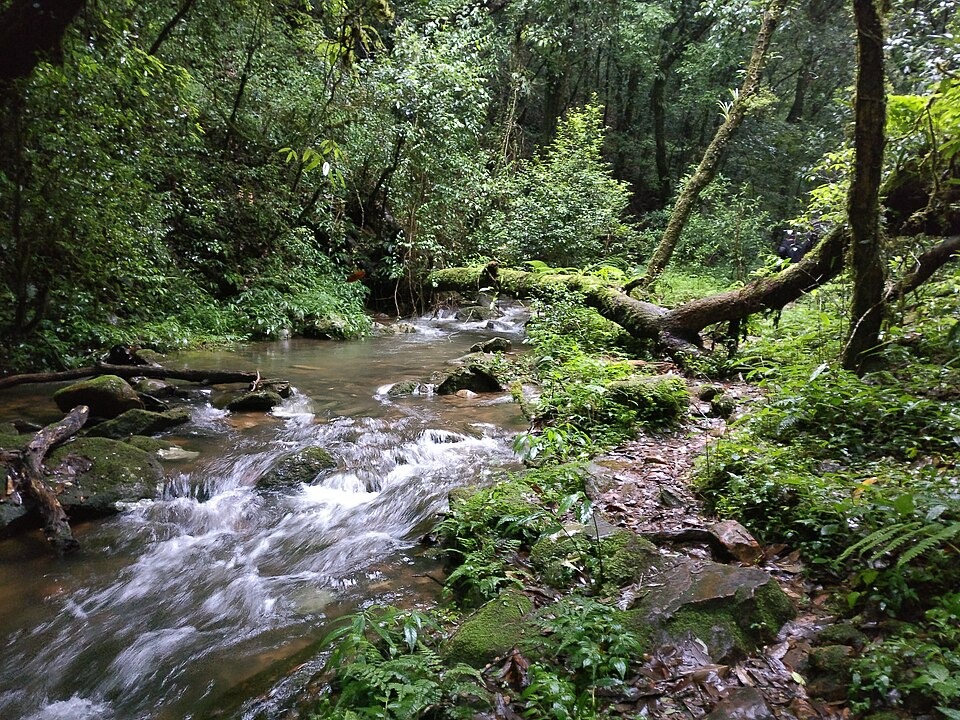
Sacred Forest, Mawphlang, Meghalaya Photo Courtsey: Ritika47/Wikimedia

Sacred Groves are across diverse ecological regions of forest protected through cultural, spiritual, and customary traditions. They represent one of the world’s oldest and most extensive community-conserved ecological networks. Although no definitive national inventory exists, estimates suggest that India hosts one of the densest concentrations of Sacred Groves globally, ranging from over 50,000 documented sites to more than 100,000 estimated groves distributed across diverse ecological and cultural landscapes [1].

Sacred Groves: Sanctuaries of Biodiversity

Amid growing biodiversity loss, ecosystem degradation, and water insecurity under climate change, these community- led institutions brings into play methods to converse biodiversity, offer ways to water security, enhance climate resilience, and enrich traditional ecological knowledge.

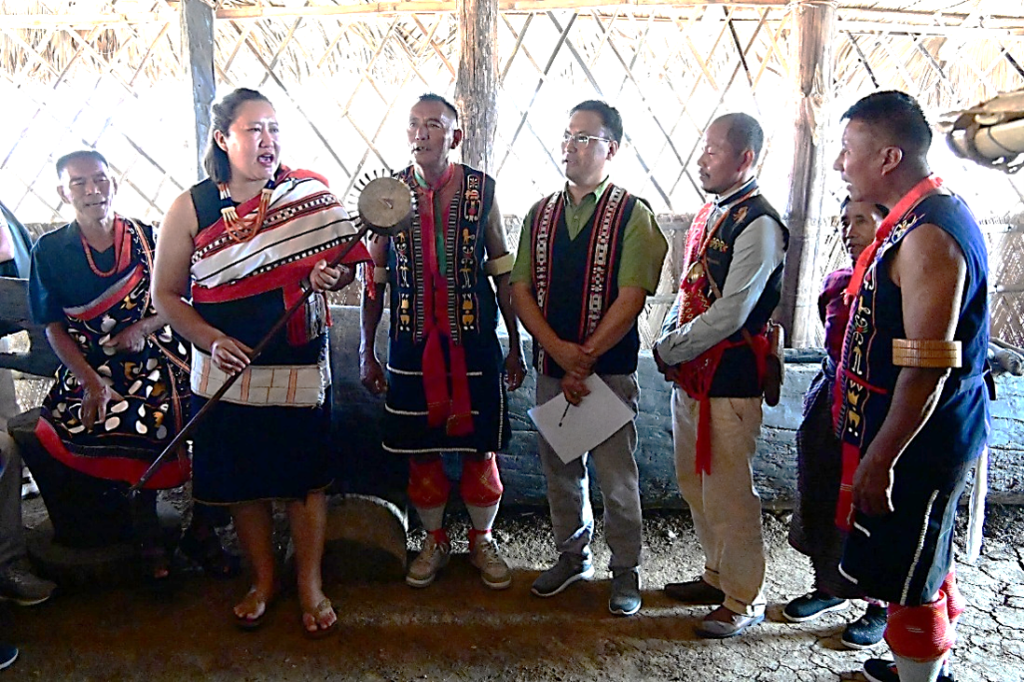
One such example emerged during Sankala Foundation’s cultural documentation in consultation with the representatives of the Chakhesang Naga community from Phek District, Nagaland during a workshop in Bhopal. They described how sacred forest patches continue to be protected through customary restrictions on hunting, tree felling, burning, and resource extraction. These forests are regarded as ancestral landscapes, with cultural and spiritual significance, where respect for nature is embedded within customary law and collective memory. Their accounts revealed that these forests are viewed not merely as natural resources but as living cultural landscapes that sustain livelihoods and community identity. Community members also expressed a belief that the well-being of people and the health of these forests are deeply interconnected.

Chakhesang Naga community members sharing and explaining their customary traditions inside a recreated traditional house at IGRMS, Bhopal Photo Courtesy: Sankala Team

Such perceptions have helped maintain a climax-community[2] in forest ecosystems and reinforce collective responsibility across generations. The significance of these traditions becomes even more apparent considering that Phek District lies within the Indo-Burma Biodiversity Hotspot. The hotspot is estimated to support approximately 13,500 vascular plant species, of which more than 7,000 are endemic . By safeguarding sacred forest patches through customary institutions, communities continue to contribute to the conservation of globally significant biodiversity.

While these observations demonstrate the social and cultural foundations of conservation, ecological evidence from other parts of India highlights the measurable outcomes of these systems.

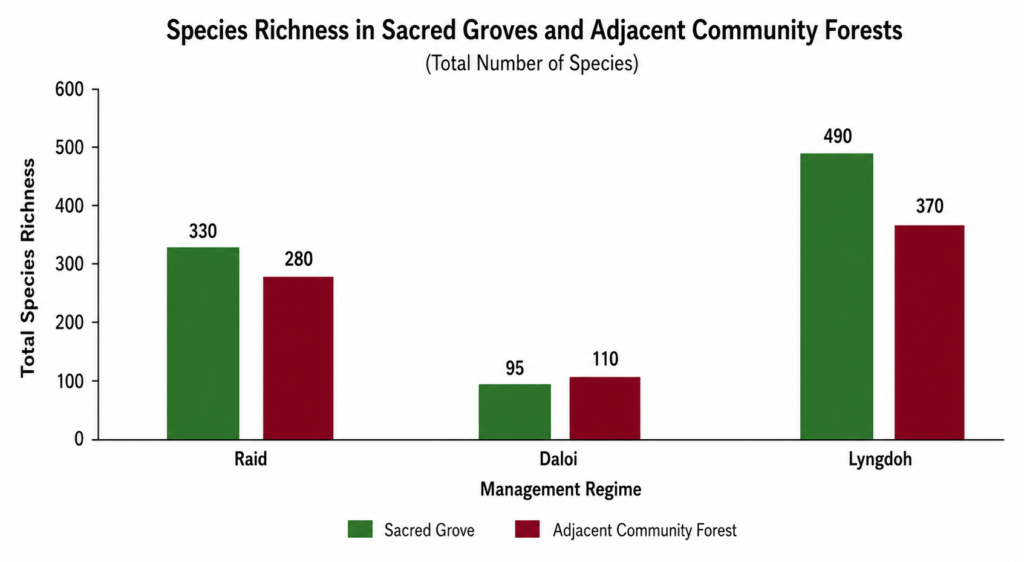
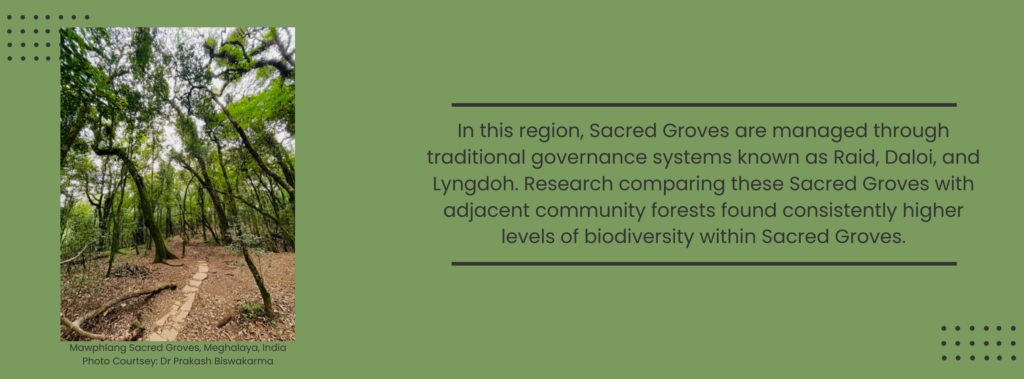
Evidence from Meghalaya provides a compelling example where the Sacred Groves are managed through traditional governance systems known as Raid, Daloi, and Lyngdoh. Across governance systems, the Sacred Groves exhibited approximately 12 per cent higher species richness than neighboring forests (Graph1). The strongest ecological outcomes were recorded under the Lyngdoh system, where Sacred Groves supported nearly 490 species compared to around 370 species in adjacent forests, representing an increase of approximately 32 per cent.

Graph 1: Species Richness in Sacred Groves and Adjacent Community Forests in Meghalaya. Data Source: Ray, Chandran & Ramachandra (2014).

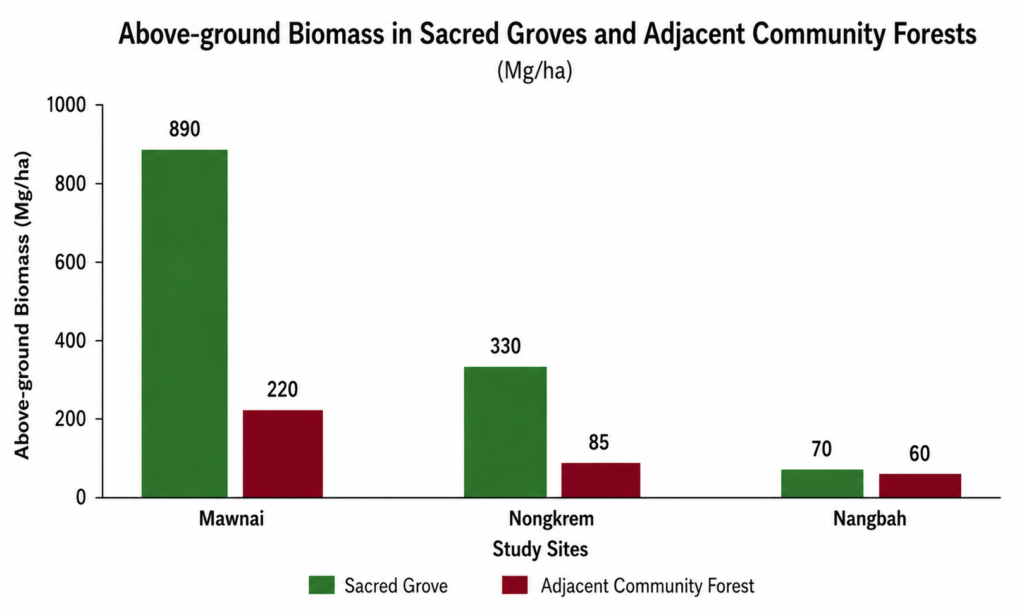
The ecological significance of Sacred Groves extends beyond biodiversity. Studies from Meghalaya revealed that the Mawnai and Nongkrem Sacred Groves stored 304% and 288% more biomass respectively than their adjacent community forests, proving local conservation significantly boosts carbon storage. (Graph 2). Overall, Sacred Groves contained approximately 253% more above-ground biomass than neighboring forests, demonstrating their powerful role as carbon reservoirs .

These findings challenge the assumption that conservation requires formal protected-area status. Instead, they show that local institutions, customary norms, and cultural values can generate measurable ecological outcomes while remaining embedded in community life.

Graph 2: Above-Ground Biomass in Sacred Groves and Adjacent Community Forests in Meghalaya. Data Source: Adapted from Ray, Chandran & Ramachandra (2014). Note: (Mg/ha; 1 Mg= 1000, kg)

These findings challenge the assumption that conservation requires formal protected-area status. Instead, they show that local institutions, customary norms, and cultural values can generate measurable ecological outcomes while remaining embedded in community life.

Enlivening Waters

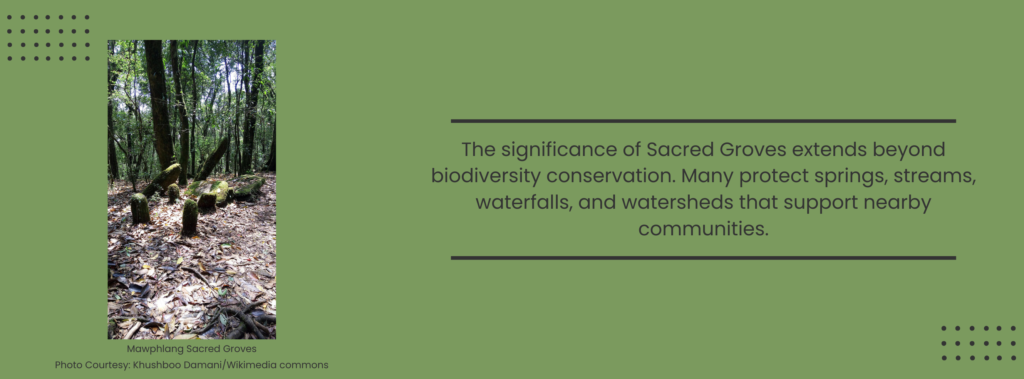
Many springs, streams, waterfalls, and watersheds are protected by the Sacred Groves enlivening nearby communities. Across India, these landscapes have often developed around important water sources, reflecting the close relationship between cultural traditions and water conservation. The Mawphlang Sacred Grove in Meghalaya, for example, safeguards perennial springs supplying surrounding settlements. Similarly, Sacred Groves in the Western Ghats protect headwater streams and catchments feeding local rivers. Research from Central Western Ghats found that sacred forest fragments maintained higher soil moisture and year-round water availability in downstream villages, while neighboring communities faced seasonal water shortages.

These findings highlight that Sacred Groves act as vital ecological buffers; by maintaining intact vegetation, they secure local watersheds, regulate temperatures, and improve soil moisture retention, significantly boosting community climate resilience (Malhotra et al., 2001; Ray et al., 2014).

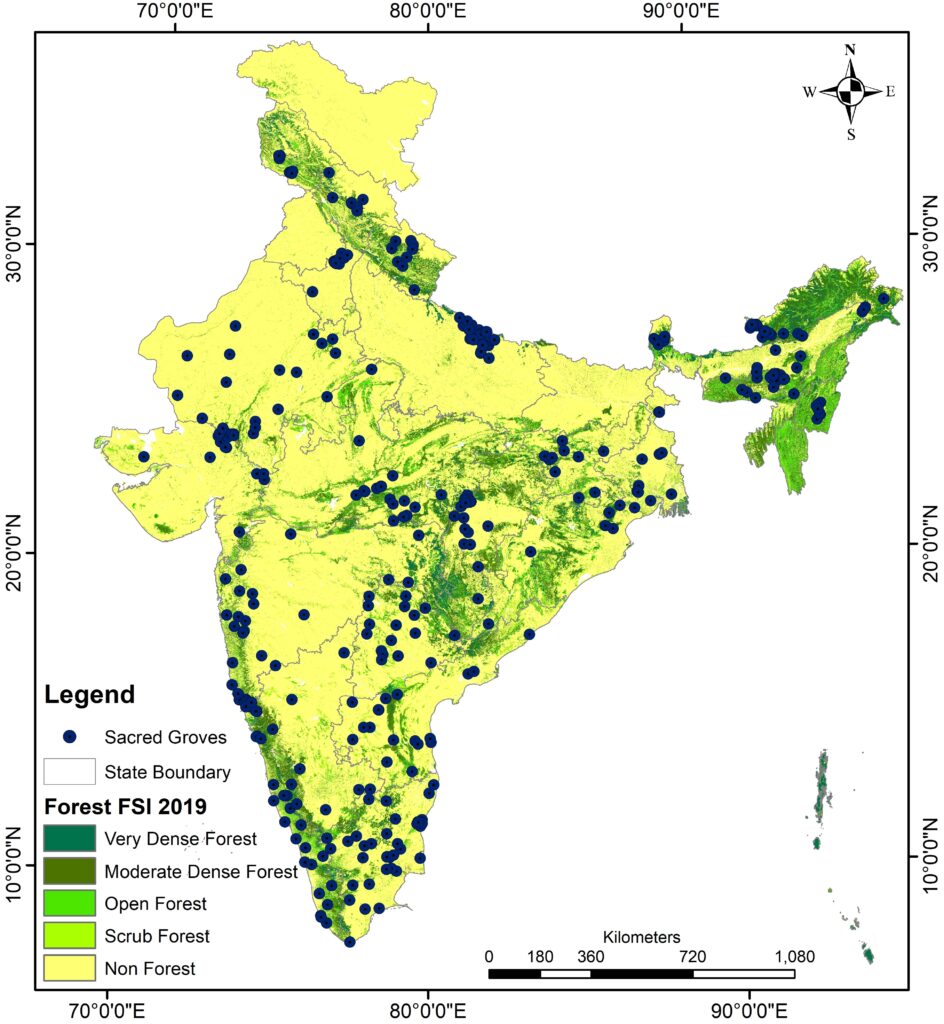
Despite their significance, Sacred Groves remain inadequately documented on the national scale. Although large numbers are believed to exist across India, geo-referenced data were available for only 319 sites in the dataset used for this analysis (Chauhan et al., 2021). Preliminary assessment indicates that many mapped groves occur within or adjacent to dense forest landscapes, highlighting their contribution to biodiversity conservation and carbon storage .

Map1: Overlap between distribution of forests and limited Sacred Groves, whose location is available. Data Source: Forest cover data adapted from Forest Survey of India (FSI), India State of Forest Report (ISFR) 2023, for Sacred Groves, Chauhan, A., Kumar, L., & Nenavath, R. (2021). Mapping sacred groves of India. Cluster Innovation Centre, University of Delhi.

These findings challenge the assumption that conservation requires formal protected-area status. Instead, they show that local institutions, customary norms, and cultural values can generate measurable ecological outcomes while remaining embedded in community life.

Groves on a Global Glance

The significance of Sacred Groves extends far beyond local landscapes. Their ecological and governance functions align closely with several national and global sustainability priorities. These include the Kunming-Montreal Global Biodiversity Framework, which emphasizes inclusive and community-based approaches to biodiversity conservation; India’s Nationally Determined Contributions (NDCs), which highlight the importance of enhancing forest and tree cover as carbon sinks; and impinges upon the Sustainable Development Goals, particularly SDG 6 (Clean Water and Sanitation), SDG 13 (Climate Action), SDG 15 (Life on Land), and SDG 11 (Sustainable Cities and Communities) (CBD, 2022; Government of India, 2022; United Nations, 2015).

By conserving biodiversity, protecting water resources, storing carbon, and sustaining traditional ecological knowledge, the Sacred Groves represent a community-driven model of cultural conservation. Their continued survival demonstrates that ecological conservation and cultural traditions can reinforce one another. As India advances its biodiversity, climate, and sustainable development ambitions, the Sacred Groves offer a proven model rooted in local knowledge, collective responsibility, and long-term stewardship. Recognizing and supporting these landscapes will help safeguard ecological heritage while strengthening resilience and sustainability.

Endnotes:

  1. Estimates vary widely due to the absence of a comprehensive national inventory, with reports ranging from several thousand documented sacred groves to over 100,000 estimated sites across India (Malhotra et al., 2001; MoEFCC, 2015).
  2. Climatic climax as described by Odum, E.P. (1969), are communities are essentially ecologically mature and relatively undisturbed ecosystems that retain high levels of biodiversity, biomass, and ecological stability.

References

  • Malhotra, K. C., Gokhale, Y., Chatterjee, S., & Srivastava, S. (2001). Cultural and Ecological Dimensions of Sacred Groves in India. Indian National Science Academy and Indira Gandhi Rashtriya Manav Sangrahalaya.
  • Chauhan, A., Kumar, L., & Nenavath, R. (2021). Mapping Sacred Groves of India. Cluster Innovation Centre, University of Delhi.
  • Convention on Biological Diversity (CBD). (2022). Kunming-Montreal Global Biodiversity Framework.
  • Forest Survey of India (FSI). (2023). India State of Forest Report 2023. Ministry of Environment, Forest and Climate Change, Government of India.
  • Government of India. (2022). Updated Nationally Determined Contribution (NDC).
  • Ministry of Environment, Forest and Climate Change (MoEFCC). (2015). National Mission for a Green India: Mission Document.
  • Myers, N., Mittermeier, R. A., Mittermeier, C. G., da Fonseca, G. A. B., & Kent, J. (2000). Biodiversity hotspots for conservation priorities. Nature, 403, 853–858.
  • Odum, E. P. (1969). The strategy of ecosystem development. Science, 164(3877), 262–270.
  • Ray, R., Chandran, M. D. S., & Ramachandra, T. V. (2014). Biodiversity and ecological assessments of Indian Sacred Groves. Journal of Forestry Research, 25(1), 21–28.
  • Ray, R., Chandran, M. D. S., & Ramachandra, T. V. (2015). Hydrological importance of sacred forest fragments in the Central Western Ghats of India. Tropical Ecology, 56(1), 87–99.
  • Sankala Foundation. (2025). Ethnographic interactions and cultural documentation with the Chakhesang Naga community, Indira Gandhi Rashtriya Manav Sangrahalaya (IGRMS), Bhopal.
  • United Nations. (2015). Transforming Our World: The 2030 Agenda for Sustainable Development


Author

  • Ms Utkarsha Rathi has a strong academic grounding in botany and environmental sciences, she brings a wealth of research experience to her analysis of the Aravallis. Her involvement in significant projects, including leading research on medicinal plants, demonstrates a deep understanding of the region's natural resources.

    View all posts

Leave a comment

Your email address will not be published. Required fields are marked *

Cart (0 items)