
Crisis within Crisis: A Gendered Analysis of Floods
The Nepal Flood Disaster
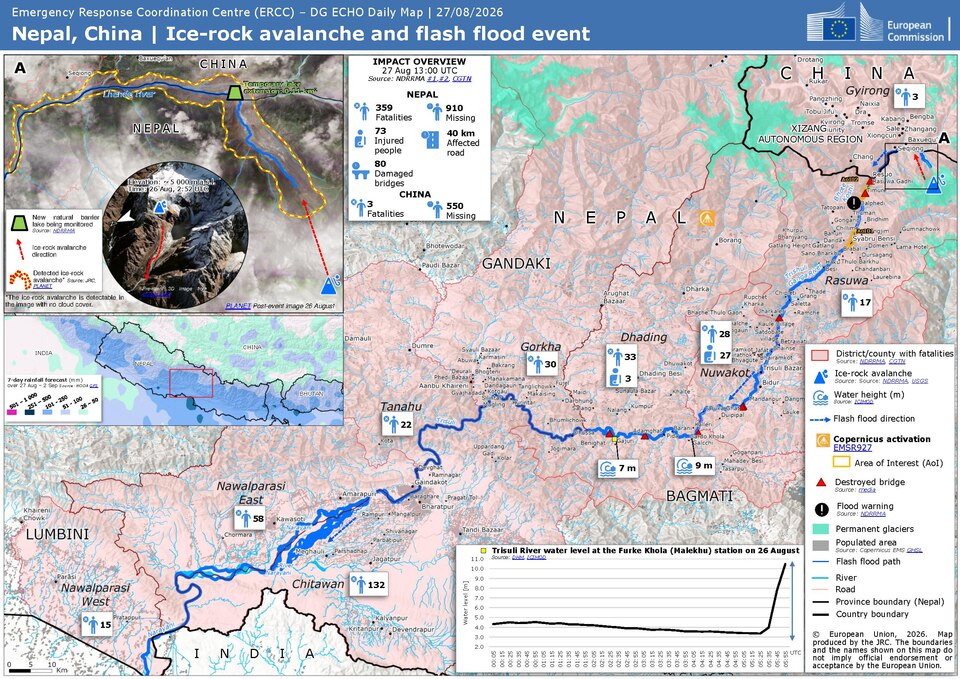
Nepal, China | Ice-rock avalanche and flash flood event (Map Courtesy: Wikimedia Commons. 27-08-2026)
Visuals from Nepal look unreal, as if they were AI-generated: a river running down angrily, eating cement houses, people, livestock, even bridges and hydropower plants. It is a peculiar time to live in, even as we witness rapid strides in technological innovation, we are also living through climate change catastrophes. Some of us more than others. This is the darkest part of it: that those who contribute the most to climate change are often the least exposed to its consequences. Bhambra and Newell argue that climate colonialism is not simply a metaphor, numbers validate it. Nepal emitted 0.05% of the world’s CO₂ emissions in 2024 (Our World in Data, 2025). Yet, its complex geography constituting low-lying plains as well as some of the world’s highest peaks, makes it particularly vulnerable to flooding and other climate-related disasters (TIME, 2026). Perhaps this is the story of climate change, a sad retelling of continuing colonialism. That though it ultimately affects everyone, not all are affected equally.
India and Floods
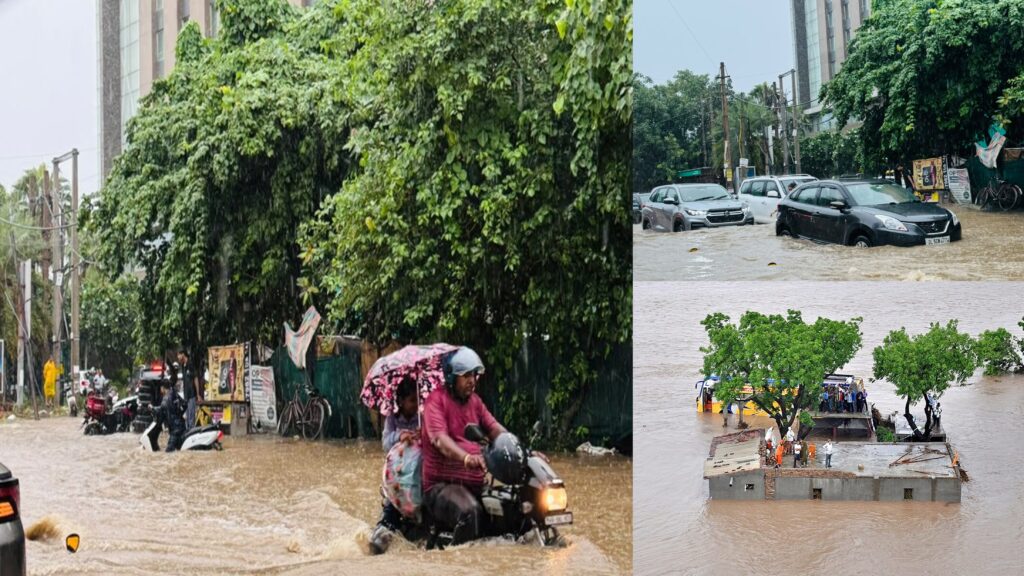
As I watch what happens to Nepal, I recall my colleagues’ reporting from Gurugram. Poor stormwater drainage infrastructure means a few hours of rain can submerge the ‘Millennium City.’ The cause and the scale of the two floods are different, but they are also similar: in both cases, water, around which life is supposed to grow, instead takes lives. Like Nepal, India is highly disaster-prone, with floods among the country’s most frequent and damaging natural disasters (UNEP, 2020). Climate-change disasters routinely disrupt drinking water and sanitation services, and this disruption is itself one of the key drivers of mortality in disasters, because it pushes people, especially the poor, toward unhygienic practices like open defecation. Floods have historically caused major outbreaks of cholera, diarrhoea, and typhoid. The 2018 Kerala floods alone caused over 3,000 cases of leptospirosis (UNICEF, 2024), a disease whose risk rises sharply after hurricanes and flood (CDC, 2024). And like with most disasters, women experience floods differently from men, and often, they come out worse off.
Clockwise from left: (i) Residents navigate floodwaters during heavy monsoon rains in Gurugram (Photo Courtesy: Sankala Foundation 2026); (ii) Flooded streets disrupt traffic and mobility in Gurugram (Photo Courtesy: Sankala Foundation 2026); (iii) Flood Affected Areas of Amreli District Gujarat India on 24 June 2015 (Photo Courtesy: Wikimedia Commons)
Floods Disrupt Sanitation Infrastructure
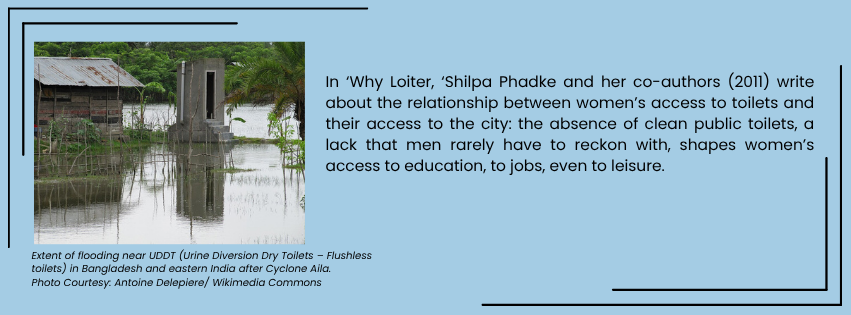
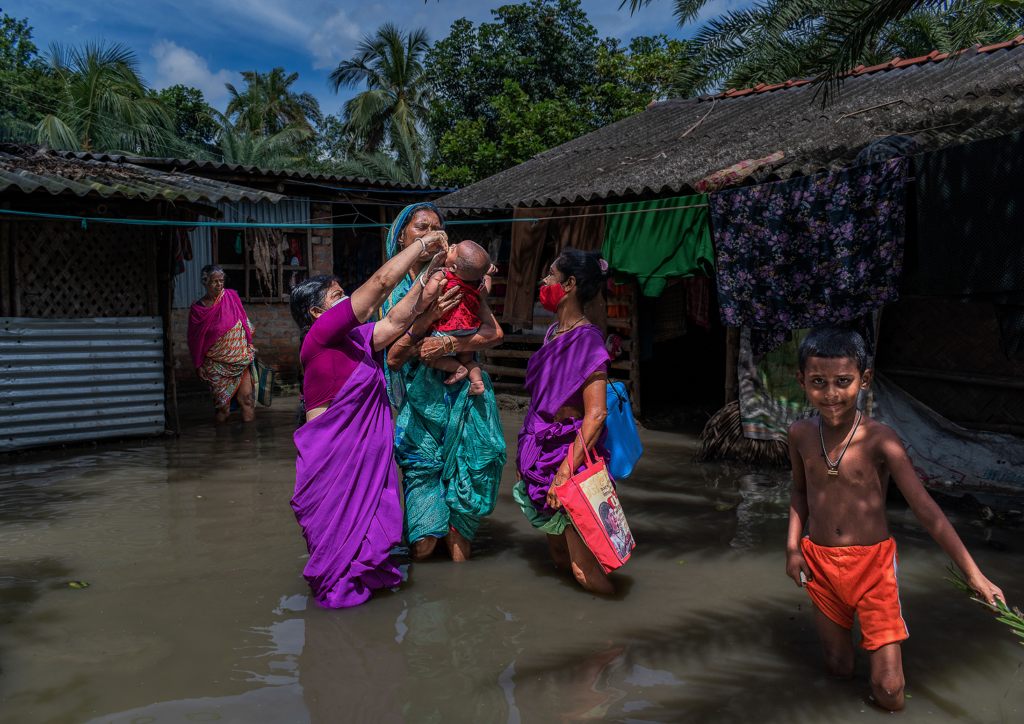
Take Gurugram. When the city floods and traffic congestion stretch into hours, women must ration their mobility and their water intake against their access to a toilet. Mothers, caught up in caregiving, live in constant fear of their children being stranded. In ‘Why Loiter’, Shilpa Phadke and her co-authors (2011) write about the relationship between women’s access to toilets and their access to the city: the absence of clean public toilets, a lack that men rarely have to reckon with, shapes women’s access to education, to jobs and leisure. The World Bank has highlighted the impact of inadequate WASH facilities on girls’ education. Similarly, Oxfam has linked poorly lit sanitation facilities to increased risks of gender-based violence, including trafficking and assault. Floods make this relationship worse. Seddighi et al. (2020) found that intimate partner violence increased in several Indian states following the 2004 Indian Ocean tsunami. Between 2010 and 2019, floods in Bihar wiped away more than half a million houses, forcing people into temporary shelters, where many women reported facing verbal and sexual harassment. It is, in UN’s words, a “crisis within a crisis”.
Floods Disrupt Drinking Water Access
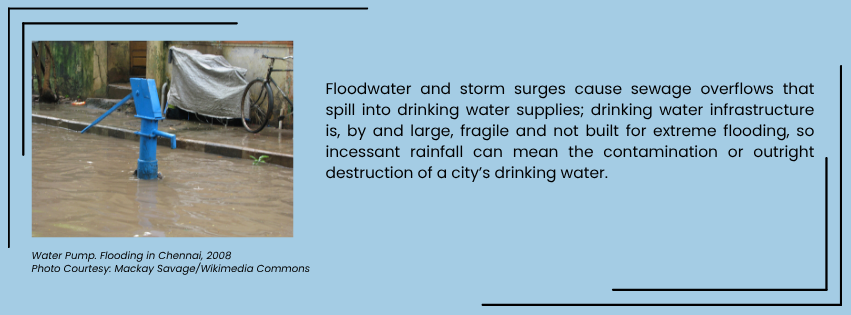
Toilets are not the only infrastructure floods affect. Floods also damage the piped supply of water and other drinking water sources. Floodwater and storm surges cause sewage overflows that spill into drinking water supplies; drinking water infrastructure is, by and large, fragile and not built for extreme flooding, so incessant rainfall can mean the contamination or outright destruction of a city’s drinking water. Gurugram is both flood-prone and at risk of water scarcity during dry periods, which means flooding here carries a double vulnerability. Flash floods can alter the quality of water, and in some cases pollute it to the point of being unfit for drinking altogether. Incessant rain can also disrupt electricity networks, which in turn disables the pumps that clean water in storage tanks. Earlier in 2026, the Times of India reported that rain-related flooding left residents of Vasai-Virar without drinking water for over 40 hours. Around the same time, the Ladakh administration reported that flash floods had damaged several water-supply systems in Kargil district, disrupting water supplies in many villages.
Globally, 26% of women and girls continue to lack access to clean drinking water. This is not only a problem of access. Water insecurity is woven into every aspect of women’s lives, and UNCCD study shows that water scarcity contributes to a rise in gender-based violence. Climate change rapidly compounds these water-related problems, and Courts have recognised this. In M.K. Balakrishnan and Ors. versus Union of India (2009), the Supreme Court recognised that the right to obtain water is part of the right to life under Article 21 of the Constitution, referring to the need to harness and store floodwater for use during periods of scarcity. But these remain mere words: access to water is not determined by the existence of water alone. A CDPP report notes that less than 10% of women affected by the devastating Kosi floods in Bihar in 2008 received any form of disaster compensation. Drinking water supply requires a range of administrative and logistical efficiency to reach people. It is also deeply a matter of who gets counted, one cannot claim relief if one is not visible to the state, which is often the case with women, and more often, with women bearing overlapping disadvantages of caste, class, religion, and geography. As Björkman claims in ‘Pipe Politics,’ water is increasingly a subject of politics, and its access is shaped by a range of factors that have little to do with rainfall.
Solutions
A recent article in The Guardian highlights how caregiving responsibilities can increase women’s vulnerability during disasters. Floods can disrupt women’s access to essential reproductive health services (Safajou et al., 2023). Women are less likely to receive early warnings in time, and more vulnerable to losing wages and work altogether. Climate change challenges cannot be addressed without considering broader developmental problems and social dimensions, including poverty and patriarchal norms (Kulkarni, 2018). Improving representation for women at various levels of water governance as well as disaster management can address parts of the problem, but climate change cannot be addressed through national-level reform alone. Nature knows no borders. Returning to climate colonialism, there is a wide gap between who causes the damage and who absorbs it, which must be addressed at the global level. As Gandhi once said, we must all live differently so all of us can live better.
References
-
- India Today. (2026, August 31). Nepal floods cause: Himalayan ice-rock avalanche, not rainfall or glacial burst.
- The Hindu. (2026, September 2). Nepal flash floods aftermath updates: Death toll near 1,250 as more than 4,000 still missing.
- Hindustan Times. (2026, August 27). UP, Bihar, Uttarakhand rush to evacuate as Nepal floods kill 160. Hindustan Times.
- CNN. (2026, August 27). What scientists think caused Nepal’s deadly flood wave.
- Bhambra, G. K., & Newell, P. (2023). More than a metaphor: ‘Climate colonialism’ in perspective. Global Social Challenges Journal, 2(2), 179–183.
- Stockholm Environment Institute (SEI). (2020). Annual report 2020.
- Our World in Data. (2025). Nepal – CO₂ and Greenhouse Gas Emissions Country Profile.
- TIME. (2026, September 1). Why Is Nepal So Vulnerable to Flooding?
- NDTV. (2026). Poor Drainage, Short-Term Fixes: Why Gurugram Submerges Every Monsoon.
- United Nations Environment Programme (UNEP). (2020, April 27). The devastating impact of floods in India—and what can be done
- UNICEF. (2022). Assessing Risks to India’s Drinking Water, Sanitation, and Hygiene Systems from Extreme Climate Events.
- Centers for Disease Control and Prevention (CDC). (2024). About Leptospirosis.
- Phadke, S., Khan, S., & Ranade, S. (2011). Why Loiter? Women and Risk on Mumbai Streets. Penguin Books India
- World Bank. (2022, May 12). Menstrual Health and Hygiene.
- Oxfam. (2021). Shining a Light: How lighting in or around sanitation facilities affects the risk of gender-based violence in camps.
- Seddighi, H., Salmani, I., Javadi, M. H., & Seddighi, S. (2020). A natural disaster and intimate partner violence: Evidence over time. Journal of Family Violence, 35, 443–453.
- International Economic Alliance. (n.d.). Why India’s women are more vulnerable to disasters.
- PreventionWeb. (n.d.). India: In Bihar, women face floods and increasing violence.
- UN Women. (2026, August 27). Nearly 160,000 women and girls impacted by Nepal flash floods.
- Rautela, A., Rawat, S., Anand, S., Negi, S. S., & Sharma, M. (2025). Evaluating the impact of flash flood on the water quality of Alaknanda river using Water Quality Index: A study from the Garhwal Himalaya, India. Geomatica, 77(2), 100065.
- Wu, J., Li, Y., Wang, C., & Chen, J. (2016). Impacts of a flash flood on drinking water quality: Case study of areas most affected by the 2012 Beijing flood. Environmental Science and Pollution Research, 23, 12447–12454
- The Times of India. (2026, July 8). No power, drinking water or mobile network for 40 hours in Vasai-Virar; flood-hit residents remain stranded.
- Administration of Union Territory of Ladakh. (2026, July 22). PHE Kargil restores drinking water supply in flash flood-affected areas through temporary arrangements; permanent restoration underway.
- UN-Water. (n.d.). Water and gende.
- United Nations Convention to Combat Desertification (UNCCD). (n.d.). Women-led solutions for drought resilience.
- M.K. Balakrishnan & Ors. v. Union of India & Ors. (2009). M.K. Balakrishnan & Ors. v. Union of India & Ors., 26 March 2009.
- Centre for Development Policy and Practice (CDPP). (n.d.). Gendered justice in disaster relief: Legal gaps in protecting women farmers from climate-induced displacement.
- Anand, N. (2017). Hydraulic city: Water and the infrastructures of citizenship in Mumbai. Duke University Press.
- The Guardian. (2026, March 27). Danger after disaster: Why emergencies come with increased risks for women.
- Safajou, F., Nahidi, F., & Ahmadi, F. (2024). Reproductive health challenges during a flood: A qualitative study. Nursing Open, 11(1), e2044.
- Economic and Political Weekly. (n.d.). How gender and caste mediate access to India’s water: A reading list.
- Bhambra, G. K., & Newell, P. (2023). More than a metaphor: ‘Climate colonialism’ in perspective. Global Social Challenges Journal, 2(2), 179–183
Author
-
View all postsBarathi Nakkeeran is an urban and environment policy researcher based in Delhi. Her work has appeared in the Economic and Political Weekly, The Hindu, Journal of International Affairs, and Down to Earth. She is a research consultant with the WASH team at Sankala Foundation.