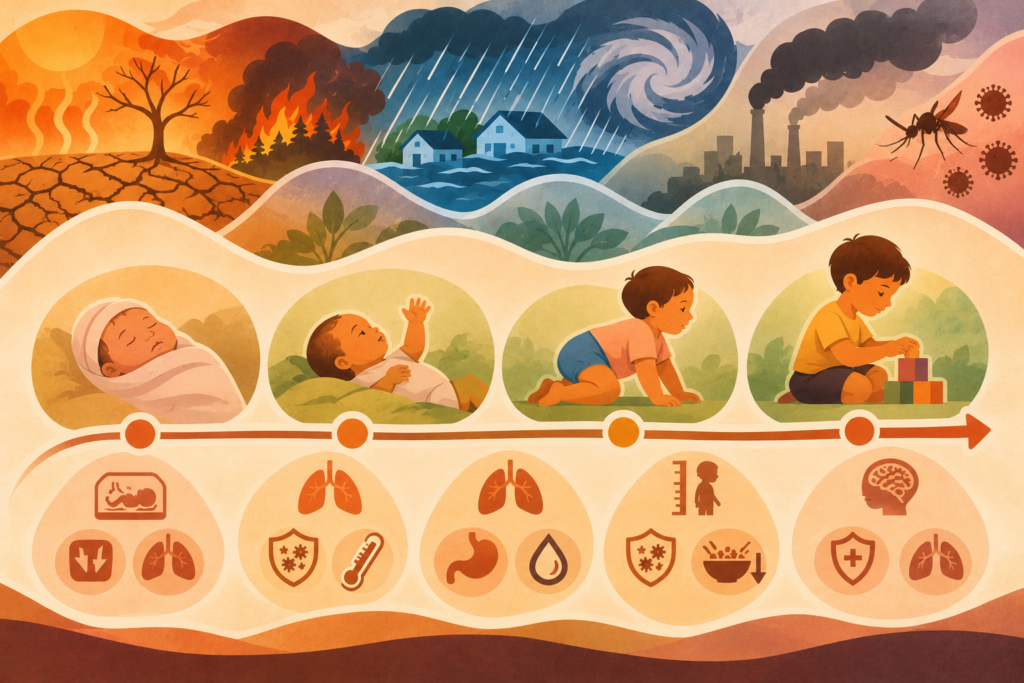
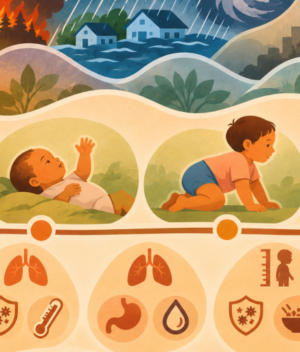
Climate-resilient healthcare must begin by recognising that children face different risks as they grow.
Climate Risks Across the First Five Years
Conceptualised by Sankala Foundation | AI-generated visual
Climate change is a global health challenge that transcends geographical boundaries, occupations and age groups, although its impacts are experienced differently across populations. Older adults, outdoor workers, pregnant women and infants are particularly vulnerable to its diverse health effects. Beyond altering the physical environment, climate change disrupts natural and human systems, affecting socioeconomic conditions, food and nutrition security, and the functioning of health systems. These disruptions threaten to undermine decades of progress in public health.
The World Health Organization estimates that 3.6 billion people already live in areas highly susceptible to climate change and projects approximately 250,000 additional deaths annually between 2030 and 2050 due to undernutrition, malaria, diarrhoea and heat stress alone. The scale of this challenge is further reflected in global food insecurity, with 770 million people facing hunger in 2020, predominantly in Africa and Asia. By affecting food availability, quality and diversity, climate change further intensifies existing food and nutrition crises (WHO, 2023). These interconnected impacts underscore the urgent need to strengthen health systems and make healthcare infrastructure more resilient to a changing climate.
A study reports that India experienced extreme weather events on 93% of days (255 out of 274 days) during the first nine months of 2024. Globally, heat-related deaths among people over 65 are now 167 per cent higher than in the 1990s. India’s gains on the Sustainable Development Goals rest on things no household controls: temperature, water, air and a steady income. The question is no longer whether climate change is a health issue, but who pays first, and whether our policies have noticed.
When Climate Change Vulnerability Becomes Health Risk
Climate vulnerability refers to the extent to which individuals, communities or systems are susceptible to harm from climate-related hazards and their ability to cope with, recover from and adapt to these impacts. It is shaped not only by exposure to climate hazards but also by the resources and capacity available to respond to them. A study by Sarfo et al. (2019) highlights how climate vulnerability can intersect with existing socioeconomic disadvantages and gaps in healthcare access, increasing the challenges faced by women and children.
An analysis of National Family Health Survey (NFHS-5) data across 575 rural districts in India found that children living in highly climate-vulnerable districts had higher odds of stunting (OR: 1.15; 95% CI: 1.109–1.198), wasting (OR: 1.06; 95% CI: 1.017–1.112) and being underweight (OR: 1.25; 95% CI: 1.203–1.299). Women in these districts also had higher odds of non-institutional deliveries (OR: 1.38; 95% CI: 1.307–1.473) and reported marginally higher odds of major problems accessing healthcare (OR: 1.009). These findings highlight the association between climate vulnerability and adverse maternal and child health outcomes in rural India. These vulnerabilities ignore state borders and affect districts and states differently. A separate analysis utilising NFHS-5 data of 674 districts found that each 1 per cent rise in the vulnerability index was associated with a lower proportion of full immunisation (0.12) and fewer four-plus antenatal visits (0.14), and higher wasting (0.07) and underweight (0.10), with 70–118 hotspot districts clustered in eastern India.
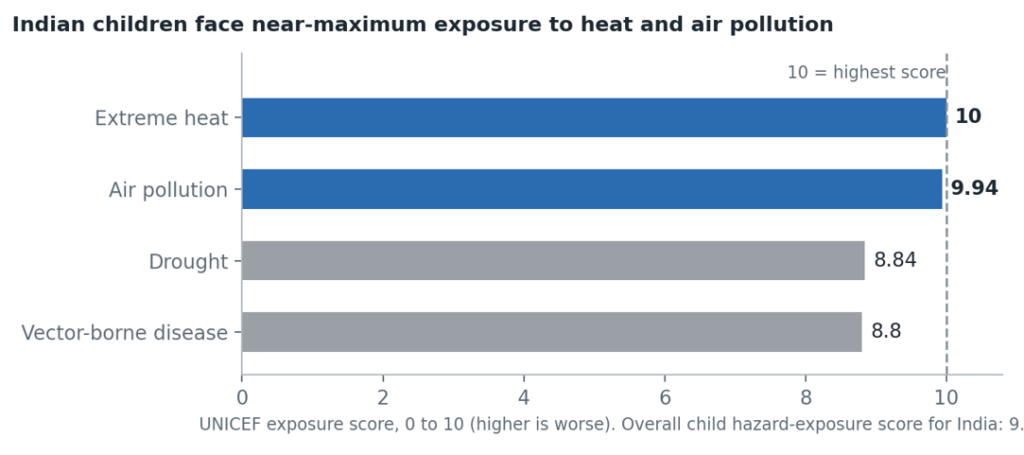
WHO (2023) describes climate change as a threat multiplier, and India’s SDG 2 score is just 52 out of 100. The children carrying that gap are the most exposed: UNICEF (2026) scores India 10 out of 10 for child exposure to extreme heat and 9.94 for air pollution (Figure 1).
Children experience the effects of climate change from an early age. Infants and people over 65 averaged 13.8 days of heatwave per person in 2023 and Ahmedabad recorded a 43 per cent jump in heat-related newborn intensive-care admissions during the May 2010 heatwave.
Floods leave their mark too: after floods in Kerala half of the schoolchildren studied still carried distressing memories (Basistha et al., 2025). Warming is also redrawing the disease map: about 76 per cent of India’s land area could face more than six months of malaria transmission a year by 2080. Each developmental stage appears to meet a different threat, from dehydration and convulsions in infancy to disrupted schooling later, so an age-blind response is unlikely to be enough.
Impacts on Himalayan Biodiversity
The slower harms are quieter and, for a child, more consequential. Stunting is the best marker because it reflects cumulative deprivation rather than seasonal swings. A spatial analysis of 640 districts (NFHS-4, 2015–16) found that approximately 39.5 per cent of children were stunted in districts where maximum temperatures exceed 40°C, and 38.1 per cent where minimums fall below 10°C. After controlling for socio-economic factors, each 1°C rise in average annual maximum temperature was associated with 0.134 percentage points more stunting (spatial error model; p < 0.10), while higher per-capita production of some crops, notably oilseeds and beverage and spice crops, was associated with lower stunting (Bharti et al., 2019).
Drought in the year of birth or the year before raised the probability of being underweight by about 1.7 percentage points among rural under-fives, consistent with the fetal-origins hypothesis that early deprivation echoes into adulthood. A South Asian scoping review links drought to stunting, floods to wasting and prenatal exposure to fine particulate pollution to stunted growth (Tiwari et al., 2022). These harms land on a heavy baseline as reported according to NFHS 5 survey, 36 per cent of Indian under-fives are stunted and 32 per cent underweight. Heat and drought also left an estimated 151 million more people food insecure in 2022 than the 1981–2010 average (Romanello et al., 2024), eroding the household incomes that sustain child nutrition.
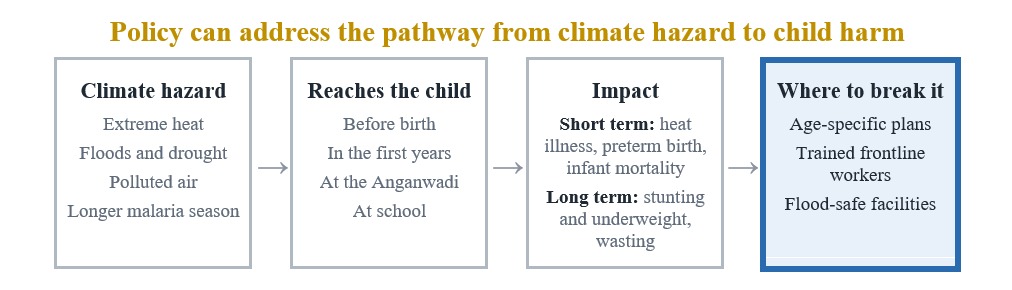
Figure 2. From climate hazard to a child’s harm, and where policy can intervene. Adapted from Basistha et al., 2025 and Dasgupta et al., 2025
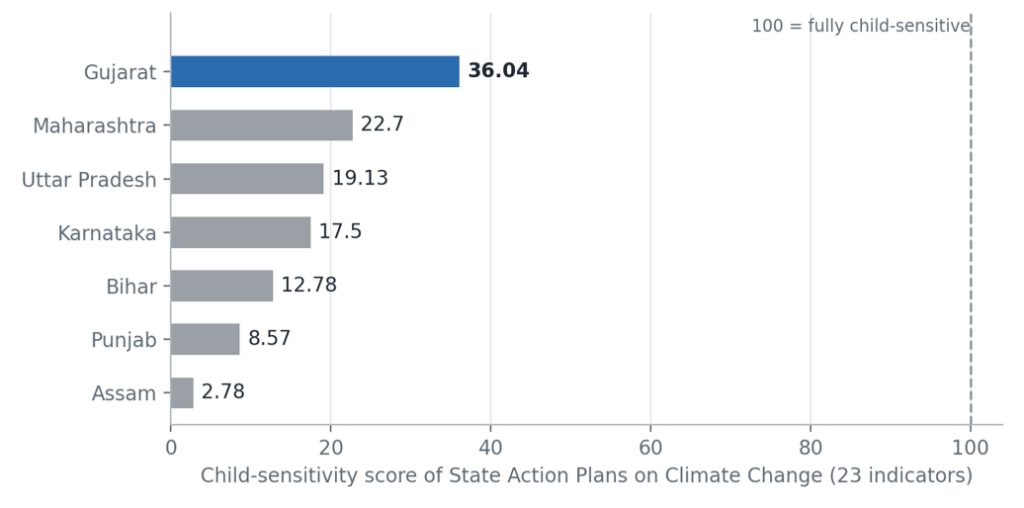
Figure 3. Child-sensitivity scores of seven State Action Plans on Climate Change. Source: Balel 2025, ECDAN (Table 7); scoring on 23 child-sensitivity indicators.
The Way Forward: Let Research Frame Policy
Research can be most helpful when it points policy toward where support is needed and whom it can reach. One promising step would be a district-level child climate-health risk atlas, bringing together hazard data with NFHS and facility records, so that plans can respond to local vulnerability and not only to averages (Dasgupta et al., 2025; Mahapatra et al., 2022; Wadhawan et al., 2025). Existing district assessments focus on overall population vulnerability or health-system risk; an atlas could add child- and age-specific outcomes. Such evidence could help bring differences in climate vulnerability into District Action Plans, the National Health Mission and the state climate and health plans now being drafted and revised. Because needs vary so widely, a tailored approach may serve best, and districts facing heat extremes, hotspot conditions or low crop production could be natural places to begin (Bharti et al., 2019; Mahapatra et al., 2022).
Children’s needs change as they grow, so state plans may benefit from provisions for pregnancy, ages 0 to 2, 3 to 5 and primary school, with Women and Child Development invited to join climate steering committees. Anganwadi workers, Accredited Social Health Activists (ASHAs) and teachers are already trusted presences in children’s lives, and they could be supported with training for heat, flood and pollution emergencies. Facilities could also be made flood-safe and water-secure, and cooler during extreme heat.
Research should increasingly focus on women and children as vulnerable populations, examining the health impacts of extreme weather events, meteorological factors and air pollution. Greater emphasis is needed on studies that directly investigate these populations to address existing evidence gaps and strengthen understanding of their specific health risks. Several of the Indian studies cited here treat under-fives as one group and some draw on earlier survey rounds, such as the District Level Household Survey (DLHS-2, 2002–04) and NFHS-4, although more recent NFHS-5 analyses are now available. The studies cited here say little about school-age children and adolescents. Researchers, health departments and communities could work together on birth cohorts that follow children from conception to adolescence, age-disaggregated surveillance of heat illness and neonatal admissions, and cross-sectoral studies that explore which interventions work best at which age. Child and adolescent mental health, and coastal and flood-prone communities, could be natural priorities for new work (Basistha et al., 2025; Tiwari et al., 2022). Existing laws and schemes could also be read through a child’s eyes, so that they serve young people more fully.
References
Balel, O. (2025). Including young children in climate actions in India: A review of seven states’ climate plans with recommendations. Early Childhood Development Action Network.
Baraik, S. K., Parihar, R. S., Sparrow, S., & Salunke, P. (2025). Exploring the nexus of climate change and vector-borne disease transmission. iScience, 28(11), Article 113835. https://doi.org/10.1016/j.isci.2025.113835
Basistha, B., Paul, F. A., Bhuyan, K., Prasad, J. S. R., & Ali, A. (2025). Climate change and mental health in India: A narrative review of vulnerabilities, impacts, and resilience pathways. Frontiers in Public Health, 13, Article 1686876. https://doi.org/10.3389/fpubh.2025.1686876
Bharti, R., Dhillon, P., & Narzary, P. K. (2019). A spatial analysis of childhood stunting and its contextual correlates in India. Clinical Epidemiology and Global Health, 7, 488–495. https://doi.org/10.1016/j.cegh.2019.04.005
Centre for Science and Environment, & Down To Earth. (2024). Climate India 2024: An assessment of extreme weather events.
Dasgupta, P., Sharma, G., Joe, W., Chowdhuri, M., & Gudakesh, G. (2025). Health SDGs are at risk from climate change: Evidence from India. PLOS ONE, 20(11), Article e0335529. https://doi.org/10.1371/journal.pone.0335529
Government of India. (2008). National action plan on climate change.
Kakkad, K., Barzaga, M. L., Wallenstein, S., Azhar, G. S., & Sheffield, P. E. (2014). Neonates in Ahmedabad, India, during the 2010 heat wave: A climate change adaptation study. Journal of Environmental and Public Health, 2014, Article 946875. https://doi.org/10.1155/2014/946875
Kumar, S., Molitor, R., & Vollmer, S. (2016). Drought and early child health in rural India. Population and Development Review, 42(1), 53–68.
Lancet Countdown on Health and Climate Change. (2024). The record-breaking human costs of climate change [Poster]. https://unfccc.int/sites/default/files/resource/Climate_change_and_human_health_impacts.pdf
Mahapatra, B., Chaudhuri, T., & Saggurti, N. (2022). Climate change vulnerability, and health of women and children: Evidence from India using district level data. International Journal of Gynecology & Obstetrics. https://doi.org/10.1002/ijgo.14515
Romanello, M., et al. (2024). The 2024 report of the Lancet Countdown on health and climate change: Facing record-breaking threats from delayed action. The Lancet, 404(10465), 1847–1896. https://doi.org/10.1016/S0140-6736(24)01822-1
Sarfo, Isaac & Boakye Yiadom, Michael & Dontoh, Jude. (2019). Concept of Climate Vulnerability: Key Determinants, Responses and Constraints to Climate Change Adaptation. Advances in Social Sciences Research Journal. 6. 232-253. 10.14738/assrj.62.6109.
Tiwari, I., Tilstra, M., Campbell, S. M., Nielsen, C. C., Hodgins, S., Osornio Vargas, A. R., Whitfield, K., Sapkota, B. P., & Yamamoto, S. S. (2022). Climate change impacts on the health of South Asian children and women subpopulations: A scoping review. Heliyon, 8(10), Article e10811. https://doi.org/10.1016/j.heliyon.2022.e10811
Wadhawan, S., Bajpai, A., Pandey, V., & Chitale, V. (2025). How can India make its health sector climate resilient? A district-level risk assessment. Council on Energy, Environment and Water.
Dr Simran Dutta is a public health professional specialising in digital health, health systems strengthening, and research. She holds a degree in Homoeopathic Medicine and a PGDM in Health Management from IIHMR, New Delhi. At Sankala Foundation, she contributes to research, policy analysis, and technology enabled solutions to improve healthcare access and outcomes.