


Balancing Survival and Reproduction: Energy Trade-offs Shaping Tiger Ecology in India
India’s remarkable success in tiger conservation is often measured by the steady rise in tiger numbers. Yet, behind every successful tiger population lies a less visible ecological process, the delicate balance between survival and reproduction.
Like all living organisms, tigers have finite energy resources. They must constantly decide where to invest that energy whether in finding food, avoiding danger, defending a territory, or raising young. Energy spent on one activity leaves less available for another. These biological trade-offs shape how animals survive and reproduce and form the foundation of life-history theory in evolutionary biology.
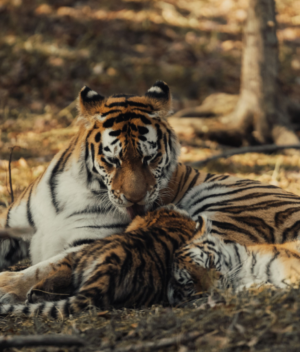
A serene moment of a tiger and its cub resting in the forest, captured in natural lighting (Photo Courtesy: Caleb Falkenhagen/ Pexel )
The concept has evolved through the work of scientists including Charles Darwin, David Lack, George C. Williams, Robert MacArthur, and Eric Charnov, whose research established energy allocation as a fundamental driver of survival and reproductive success across species.
For tigers, reproduction is therefore not merely a biological process, but an energy-budget decision shaped by prey abundance, territorial security, maternal investment, and environmental disturbance. Understanding these trade-offs provides valuable insights into tiger ecology and highlights why effective conservation must go beyond protecting the species itself to ensuring prey availability, habitat integrity, and stable ecological conditions that sustain healthy tiger populations.
How Energy Shapes Tiger Reproduction
The energetic demands of reproduction differ significantly between female and male tigers, reflecting their distinct reproductive roles. While females invest most of their energy in producing and raising offspring, males expend considerable energy in establishing territories, competing with rivals, and securing mating opportunities. Together, these contrasting strategies illustrate how energy allocation shapes reproductive success.
Female Tigers: The High Cost of Reproduction
For female tigers, reproduction is one of the most energetically demanding phases of life. From gestation and lactation to raising cubs for up to two years, every stage requires substantial energy. These demands create several ecological trade-offs that directly influence reproductive success.
- High maternal investment: A tigress must sustain gestation, lactation, one of the highest caloric demands in mammalian reproduction, and care for her cubs for up to two years, requiring a significant increase in hunting effort.
- Hunting v/s cub protection: Every hunting excursion provides the food needed to sustain both the mother and her cubs, but leaving cubs unattended exposes them to threats such as infanticide by rival males and predation by other carnivores. This creates a constant trade-off between acquiring food and protecting offspring.
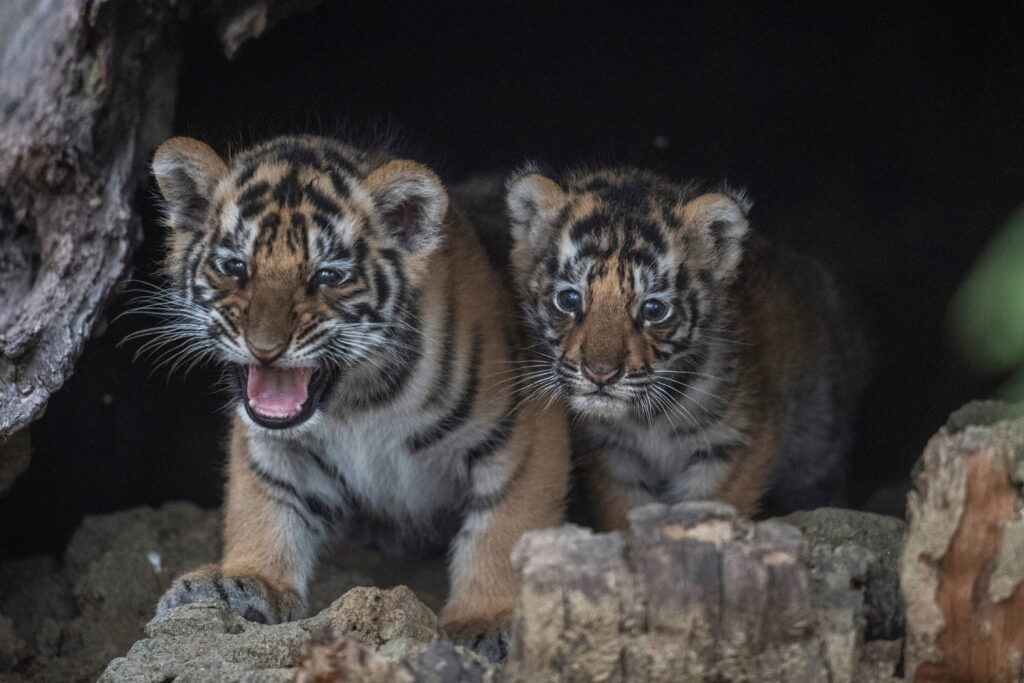
Tiger cubs in Kanha Tiger Reserve, Madhya Pradesh ( Photo Courtesy: Dr Sanjay Kumar Shukla)
- Adaptive strategies: To balance these competing demands, tigresses select secure den sites, restrict their movements during the early stages of cub rearing, and hunt close to the den. Telemetry studies by Yogesh Kumar Jhala and colleagues have shown that tigresses modify their movement patterns and habitat use while rearing cubs, reflecting behavioural adaptations that balance energy requirements with offspring protection.
- Reproductive decisions: Energy constraints also shape breeding strategies. Although tigresses typically produce litters of two to four cubs, not all survive to adulthood. They may also delay breeding when prey is scarce or habitats are disturbed, reproducing only under favourable conditions. Long-term observations from Panna National Park suggest that prey availability, territorial stability and environmental conditions are key factors influencing reproductive success (Chundawat, 201).
Male Tigers: A Different Energy Strategy
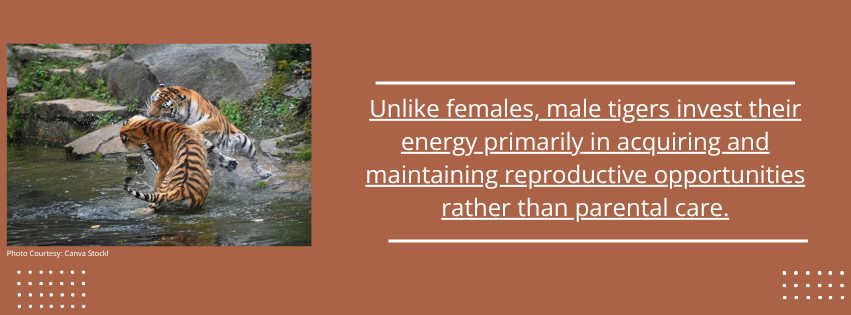
Unlike females, male tigers invest their energy primarily in acquiring and maintaining reproductive opportunities rather than parental care. Their reproductive success depends on:
- Territorial defence: Continuous patrolling, scent marking, and defending territories that provide access to females demand substantial energy.
- Competition with rivals: Frequent confrontations with rival males increase energy expenditure and the risk of injury or death.
- Territory size vs. breeding opportunities: Defending a larger territory may increase access to females but also requires greater energetic investment. Smaller territories conserve energy but often offer fewer mating opportunities.
- Territorial turnover: Changes in dominant males may lead to infanticide, an evolutionary strategy that brings females back into breeding condition sooner but also increases cub mortality and reduces population stability.
These energy trade-offs are not limited to reproduction. Similar decisions can be seen in other large carnivores. Leopards, for example, may hoist their kills into trees when faced with competitors such as hyenas. By moving a carcass out of reach of ground-based competitors, they reduce the risk of losing an energetically costly food resource. Such behaviour illustrates a broader principle of carnivore ecology: energy already invested in obtaining food must also be protected from competing demands.
Together, these contrasting strategies demonstrate that successful tiger reproduction depends not only on biological capability but also on ecological conditions. Prey abundance, habitat security, territorial stability, and minimal disturbance determine how effectively both males and females can allocate energy towards reproduction, highlighting the importance of ecosystem-based conservation.
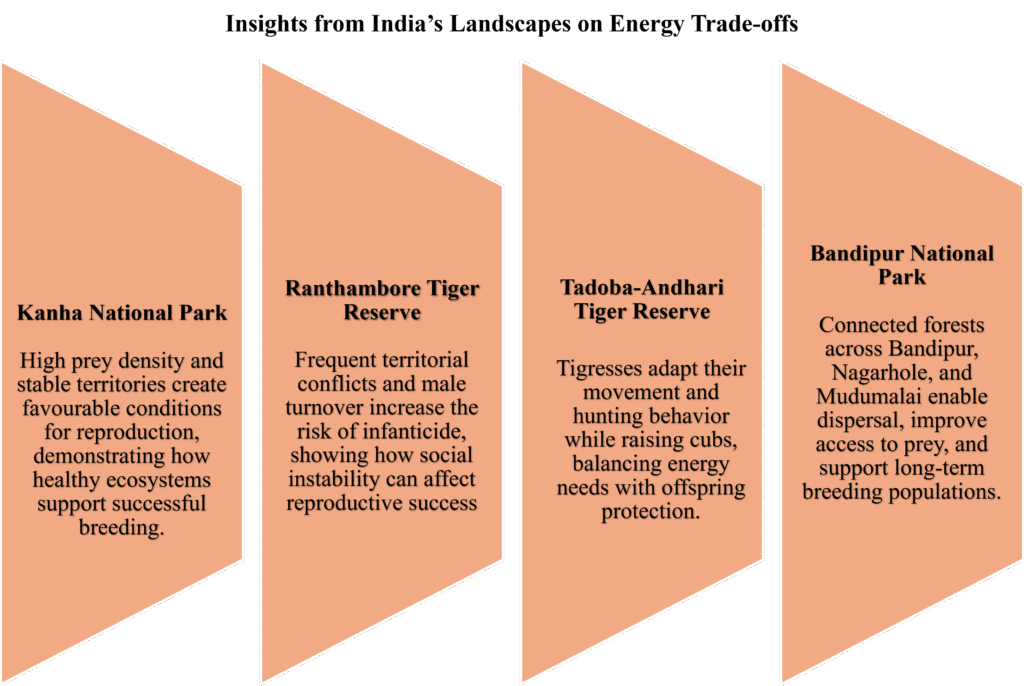
Lessons on Energy Trade-offs from India’s Tiger Landscapes
Across India’s tiger landscapes, reproductive success is shaped by a complex balance of ecological factors rather than a single condition. While each landscape highlights different energy trade-offs, from prey availability and territorial stability to habitat connectivity. Research by Karanth et al. (2004) demonstrated that prey abundance is the strongest predictor of tiger density across India’s forests, highlighting the importance of prey-rich habitats in sustaining viable tiger populations.
Conclusion
India’s tiger landscapes convey that conservation is shaped as much by ecological processes as by protection measures. Behind every successful breeding population lies a complex balance of prey availability, habitat security, social stability, and behavioural adaptation.
Understanding how tigers allocate energy offers a deeper perspective on their ecology. It explains why some populations thrive while others struggle, and why recovery depends not only on protecting tigers but also on maintaining the ecological conditions that support reproduction.
Ultimately, conserving tigers means conserving the ecosystems that sustain them. When prey, habitats, and landscapes remain healthy, nature creates the conditions for the next generation of tigers to thrive.
References
- Karanth, K. U., Nichols, J. D., Kumar, N. S., Link, W. A., & Hines, J. E. (2004). Tigers and their prey: Predicting carnivore densities from prey abundance. Proceedings of the National Academy of Sciences, 101(14), 4854–4858. https://doi.org/10.1073/pnas.0306210101
- Chundawat, R. S. (2018). The Rise and Fall of the Emerald Tigers: Ten Years of Research in Panna National Park.
- Majumder, Aniruddha & Basu, Santanu & Sankar, Kalyanasundaram & Qureshi, Qamar & Jhala, Yadvendradev & Nigam, Parag & Gopal, Rajesh. (2012). Home ranges of Bengal tiger (Panthera tigris tigris L.) in Pench Tiger Reserve, Madhya Pradesh, Central India. Wildlife Biology in Practice. 8. 10.2461/wbp.2012.8.4.
This blog is based on original article written by Mr. Hemanth Kumar. The views expressed are those of the author. Data cited from the article entitled “Balancing Survival and Reproduction: Energy Trade-offs Shaping Tiger Ecology in India”
Read Full Article: https://www.linkedin.com/pulse/balancing-survival-reproduction-energy-trade-offs-kumar-ifs-retd–uem9c?utm_source=share&utm_medium=member_ios&utm_campaign=share_via
Author
-
View all postsHemanth Kumar is a retired Indian Forest Service (IFS) officer and served as Principal Chief Conservator of Forests (PCCF), Uttar Pradesh. Currently, he is a special monitor, tribals at the National Human Rights Commission (NHRC).