

Humans Living with Tigers: How Gond Art Portrays Coexistence

For generations, tribal communities have seen the tiger not as a threat, but as a guardian of the forest. Through Gond art, this enduring relationship between people, forests and tigers continues to be preserved.

Art has always been one of humanity’s oldest forms of expression. Long before written language, early Homo sapiens painted animals, hunting scenes and everyday life on cave walls, preserving their experiences for future generations. Thousands of years later, art continues to tell stories, not only of people, but also of the landscapes they inhabit and the relationships they share with nature.

For India’s tribal communities, this tradition lives on through Gond art. More than a traditional painting style, it is a way of preserving stories, beliefs and lived experiences, reflecting the deep relationship between people, forests and wildlife.

These stories come together at Sankala Foundation’s annual exhibition, Silent Conversation: From Margins to the Centre organised by Sankala Foundation with the support of the National Tiger Conservation Authority (NTCA), the International Big Cat Alliance (IBCA) and the Ministry of Environment, Forest and Climate Change (MoEFCC), the exhibition has, over the years, brought together the works of more than 400 tribal artists from India’s tiger reserves. Across its annual editions, Silent Conversation has been graced by eminent dignitaries, including former President of India Shri Ram Nath Kovind, Hon’ble President of India Smt. Droupadi Murmu, Union Minister of External Affairs Dr. S. Jaishankar, Union Minister for Environment, Forest and Climate Change Shri Bhupender Yadav, former Minister of State for Environment, Forest and Climate Change Shri Ashwini Kumar Choubey, and Hon’ble Minister of Culture and Tourism Shri Gajendra Singh Shekhawat. Through these artworks, the exhibition celebrates the enduring relationship between tribal communities and tigers, offering a unique perspective on coexistence rooted in culture, tradition and lived experience.

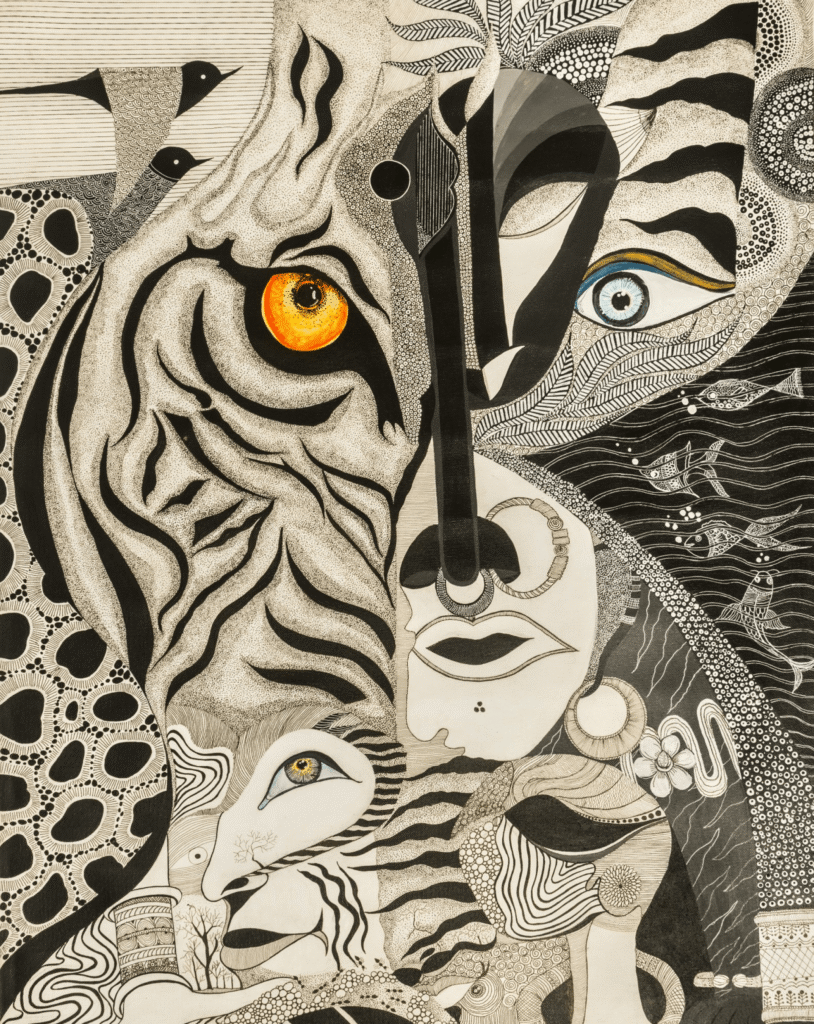
Coexistence, Painting by Sumitra Dashrath Ahake
(Photo Courtesy: Sankala Team)
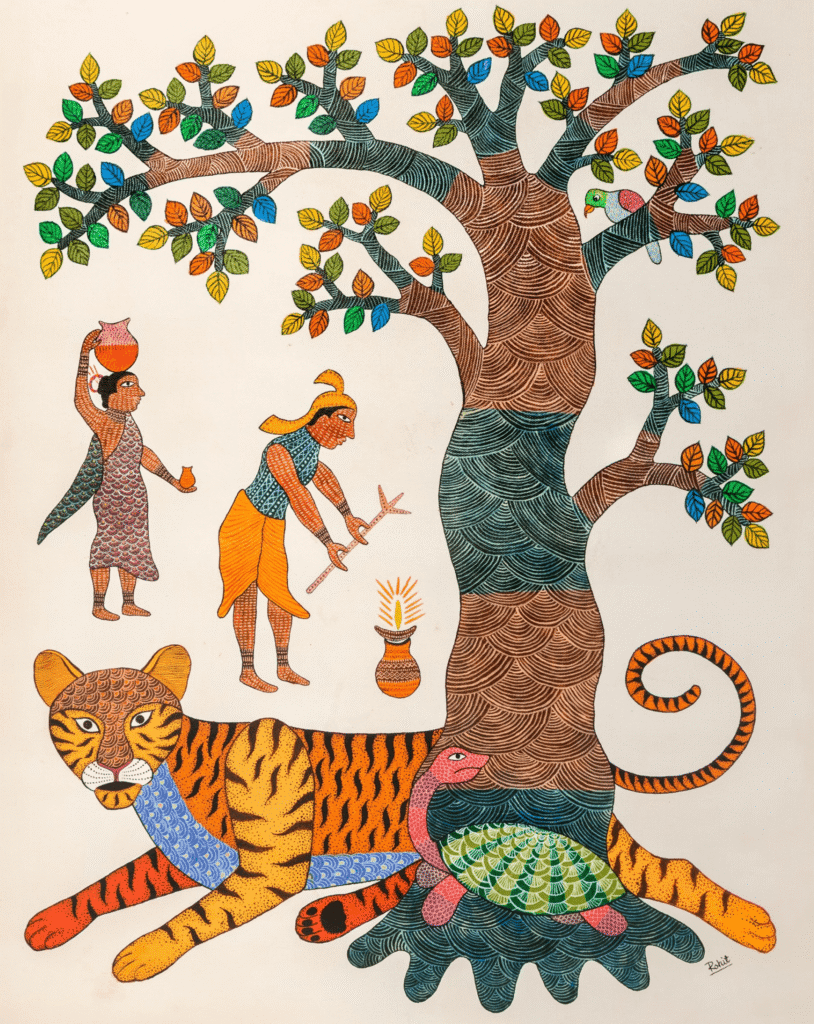
Sacred Bond of the Gond, Painting by Rohit Shukla
(Photo Courtesy: Sankala Team)

Understanding Gond Art

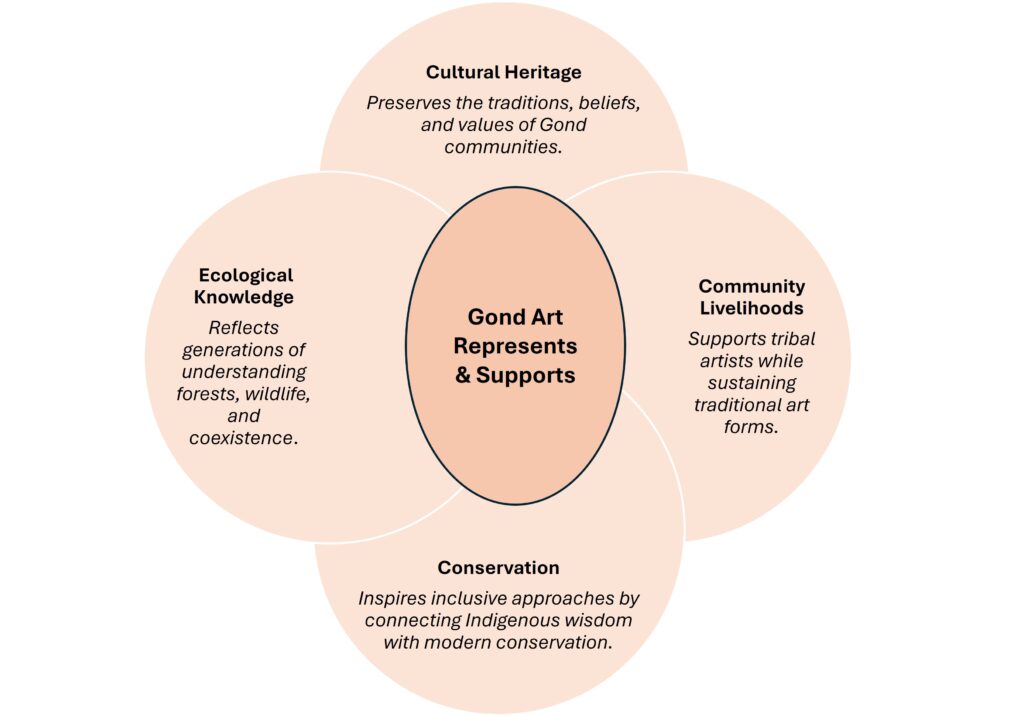
Practised by the Gond community, one of India’s largest tribal groups, Gond art is among the country’s oldest tribal painting traditions, with a history spanning nearly 1,400 years. The word Gond is derived from the Dravidian word Kond, meaning “green mountain,” reflecting the community’s close association with forests and nature. Originating in the villages of central India, these paintings were traditionally created on the mud walls and floors of homes using natural pigments made from soil, charcoal, leaves and flowers.

Characterised by vibrant colours, intricate patterns and meticulous arrangements of dots and lines, Gond paintings transform stories into vivid visual narratives. Drawing inspiration from folklore, ancestral beliefs and everyday life, artists depict forests, rivers, birds, animals and sacred motifs such as the Tree of Life, with every element carrying symbolic meaning. While the art form has gradually moved from village walls to paper and canvas, its purpose remains unchangedto preserve cultural memory, celebrate nature and pass ecological knowledge from one generation to the next. It is within this rich artistic tradition that the tiger emerges as Bagh Dev, the guardian spirit of the forest and a powerful symbol of coexistence.

Stories Woven in Gond Art

At the heart of Silent Conversation: From Margins to the Centre are the artists whose works bring these stories to life. Drawing inspiration from their communities, forests and lived experiences, each painting offers a unique interpretation of the enduring relationship between people and the tiger.

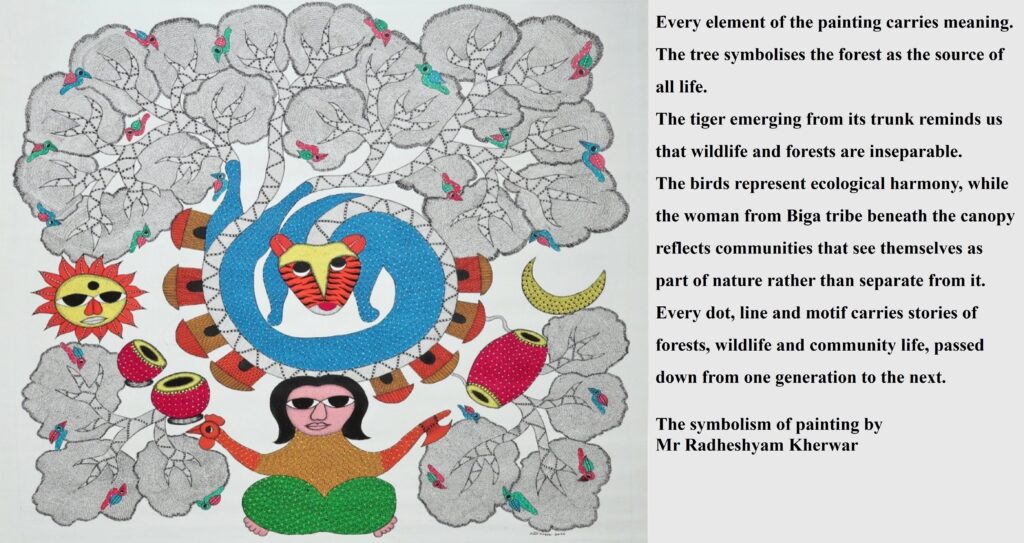
Radheshyam Kherwar: Painting the Spirit of the Forest

Growing up near Kanha Tiger Reserve, 39-year-old Radheshyam Kherwar discovered Gond art through the murals that decorated homes in his village. He has been painting since 2009 and now exhibits his work across India while also illustrating stories for children’s magazines.

When we asked what inspired this painting, he smiled and simply said:

“Bagh hi jungle ki aatma hai. Hum apne purkhon se suni hui kahaniyon ko rangon mein utarte hain, jahan insaan, jungle aur vanya jeev ek saath rehte hain.”

(“The tiger is the soul of the forest. We paint the stories passed down by our ancestors, where people, forests and wildlife exist together.”)

A Gond Painting titled ‘Bagh Dev’ by Radheshyam Kherwar, portraying the sacred relationship between people, forests and the tiger. (Photo courtesy: Sankala Foundation)

Radheshyam’s painting portrays the tiger as the very spirit of the forest, where every tree, bird and human figure is intricately connected. It reflects a belief that the well-being of the forest and the presence of the tiger are inseparable, existing in harmony with one living landscape.

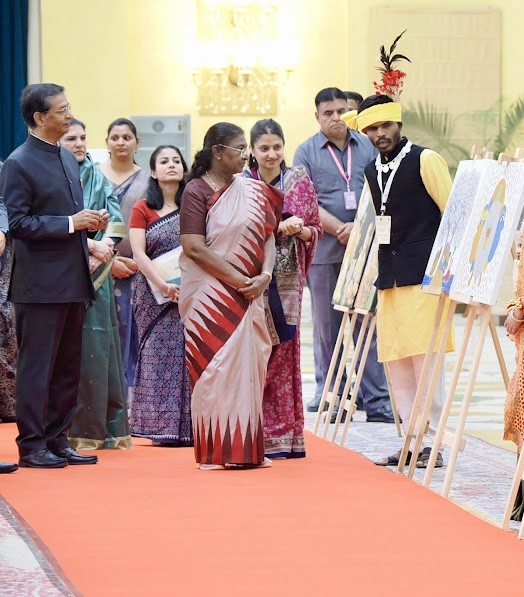
Hon’ble President of India, Smt. Droupadi Murmu, accompanied by Mr Bharat Lal, Secretary General and CEO of the National Human Rights Commission (NHRC), looking at Gond artist Radheshyam Kherwar’s painting during Silent Conversation: From Margins to the Centre at the Rashtrapati Bhavan Museum, 2023.

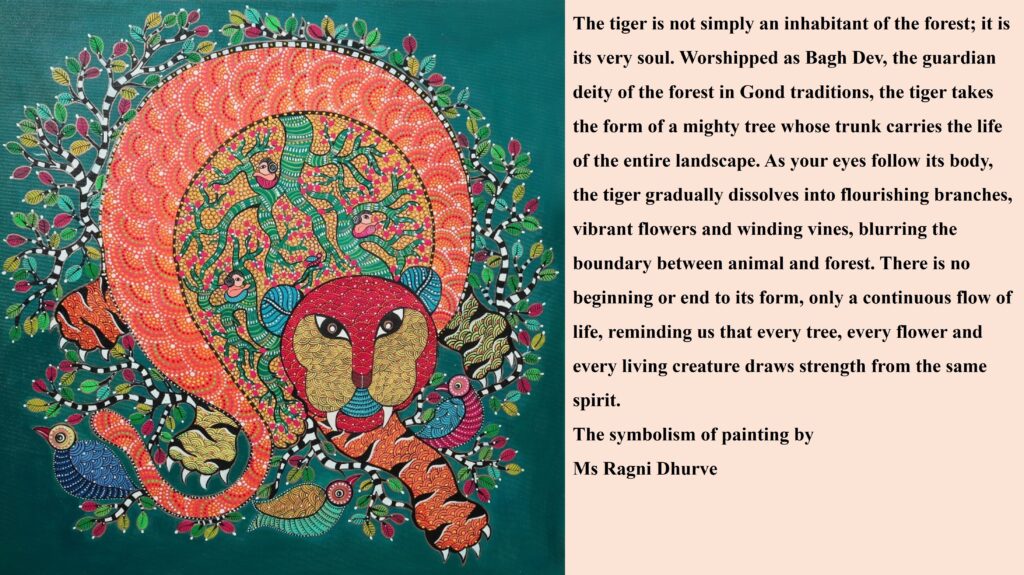
Ragni Dhurve: A New Generation, the Same Belief

Hundreds of kilometres away, in the Achanakmar Tiger Reserve landscape of Chhattisgarh, 24-year-old Gond artist Ragni Dhurve tells a remarkably similar story through her art. Entirely self-taught, she began painting at the age of six by observing artists in her village, gradually refining her craft through years of practice. Her vibrant painting, with its intricate patterns and bold colours, was among the works that immediately caught our attention at the exhibition.

When asked about the meaning behind her painting, Ragni simply replied,

“Sher jungle ki aatma hai, aur wahi hamare dev hai.”

(“The tiger is the soul of the forest, and our deity.”)

Gond artist Ragni Dhurve’s artwork titled “Jungle ki Aatma”, showing the tiger as the soul of the forest. (Photo courtesy: Sankala Foundation)

In Ragni’s painting, the tiger is woven into the forest itself. Trees, flowers and winding branches flow through its form, blurring the boundary between the animal and the landscape. While her artistic style differs from Radheshyam’s, both artists express the same enduring belief, that the forest and the tiger are inseparable, each giving meaning to the other.

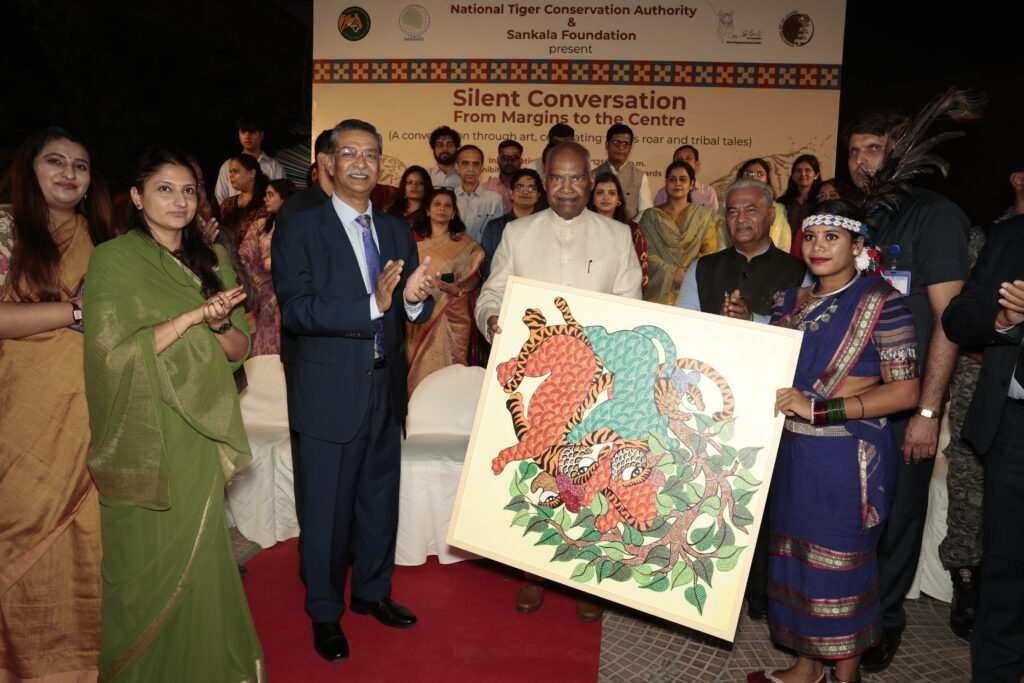
Gond artist Ragni Dhurve presents her artwork to Hon’ble Former President of India, Shri Ram Nath Kovind, in presence of Mr Bharat Lal, Secretary General and CEO of the National Human Rights Commission (NHRC), and Mr SP Yadav, Director General of the International Big Cat Alliance (IBCA) and Sankala team during Silent Conversation: From Margins to the Centre, 2025.

Tribal Knowledge and Conservation

The stories of Radheshyam and Ragni reflect what research is increasingly recognising: that for many tribal communities, coexistence is a way of life, rooted in generations of knowledge, cultural traditions and lived experience. Scholars such as Ambika Aiyadurai (2016) and Meera Anna Oommen (2021) have documented these enduring relationships, showing how tribal communities have long shared landscapes with wildlife through traditions rooted in respect, culture and lived experience.

Initiatives such as Silent Conversation: From Margins to the Centre help bring these voices to a wider audience by celebrating Gond art, supporting tribal artists and highlighting traditional knowledge as an important part of conservation. More than a showcase of paintings, the exhibition reminds us that protecting India’s tigers is also about preserving the cultures, stories and communities that have lived alongside them for centuries.

References

Author

  • Anjali Lomas is a Research Associate at Sankala Foundation and holds a master’s degree in Environment and Development from Dr. B.R. Ambedkar University, Delhi. Her work focuses on human–wildlife conflict, biodiversity conservation, community-based environmental management, and environmental policy.

    View all posts
Cart (0 items)