India’s population is ageing, and its cancer burden is climbing. For people aged 60 and above, cancer can be a tougher fight when compounded by frailty and comorbidities. With specialised geriatric oncology care still limited, India has a long way to go.
The Burden: A Nation Ageing Faster Than It Can Care
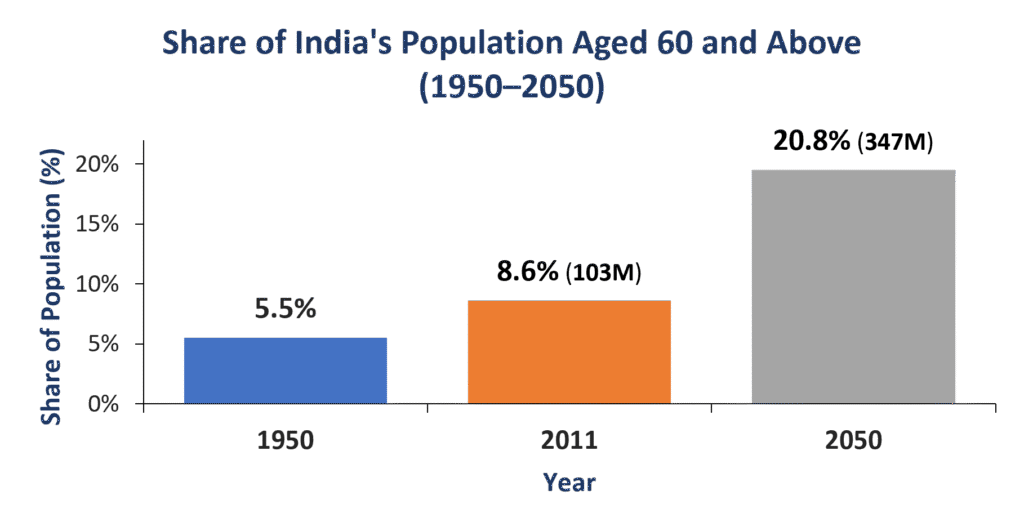
India embodies this shift starkly driven by increasing longevity and declining fertility, the proportion of elderly population is expected to increase to 347 million by 2050 according to the United Nations Population Fund (UNFPA) 2023 Ageing Report. GLOBOCAN 2020 recorded 1,324,413 new cancer cases in the country; National Cancer Registry Programme (NCRP) data put 2023 incidence at roughly 1.39 million, projected to reach 1.57 million by 2050.
Advancing age is a major risk factor for cancer, with people aged 65 years and above accounting globally for approximately 60% of newly diagnosed malignancies and 70% of cancer deaths. As India’s population ages, the implications of this relationship are expected to become increasingly important for the country’s cancer prevention, diagnosis, treatment and geriatric-care systems (Figure 1).
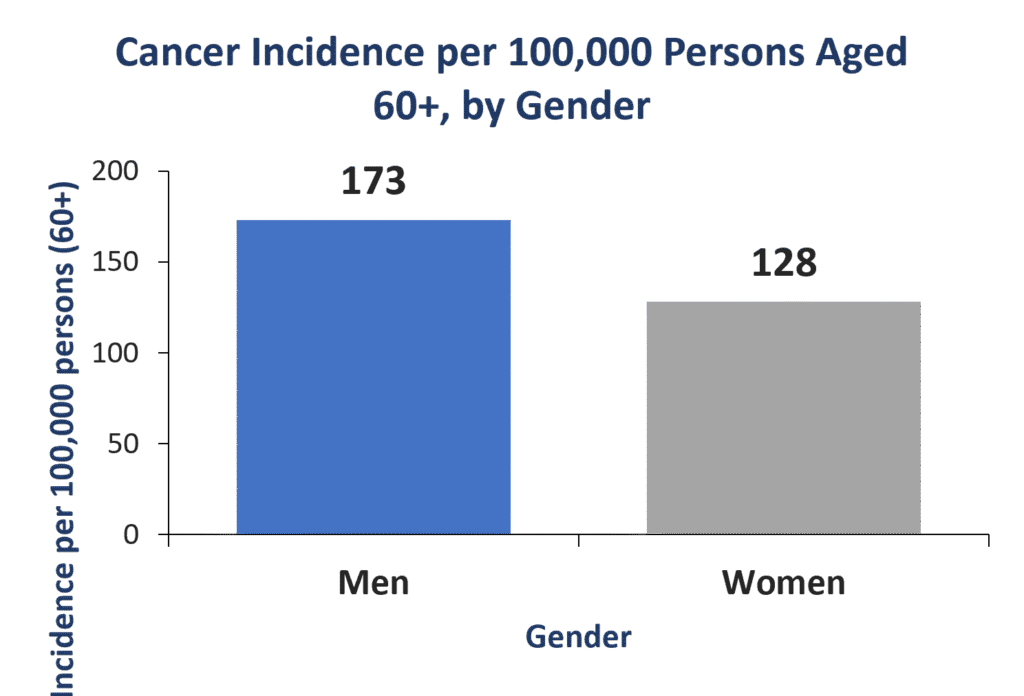
Cancer among India’s elderly is unevenly distributed and the Ministry of Statistics and Programme Implementation (MoSPI) Elderly in India 2021 report states that men record 173 cancer cases per 100,000 against 128 for women, suggesting that self-reported awareness and actual incidence diverge sharply by gender, likely reflecting women’s lower access to diagnosis rather than lower true risk (Figure 2).
Figure 2 Adapted from Elderly in India 2021 report, MoSPI.
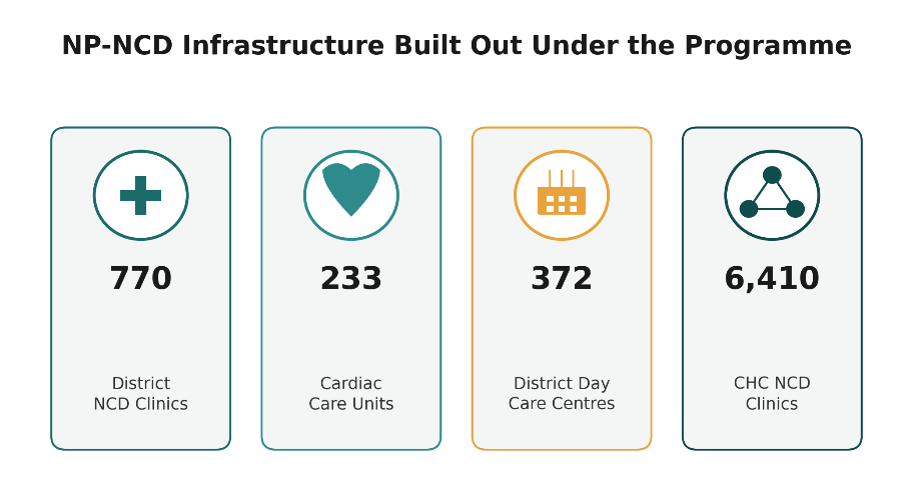
Recognising the growing cancer burden, the Government of India launched National Programme for Prevention and Control of Cancer, Diabetes, Cardiovascular Diseases and Stroke (NPCDCS), piloted in 2010 across 100 districts in 22 states and scaled up in phases thereafter. This institutional groundwork has translated into tangible infrastructure on the ground.
This programme was reinforced in 2018 by the roll-out of Ayushman Bharat Health and Wellness Centres (now Ayushman Arogya Mandirs) for primary care, and in 2023 by revised NP-NCD operational guidelines (2023–30) that sharpen the focus on primary and secondary prevention and better integration of NCD care across delivery levels.
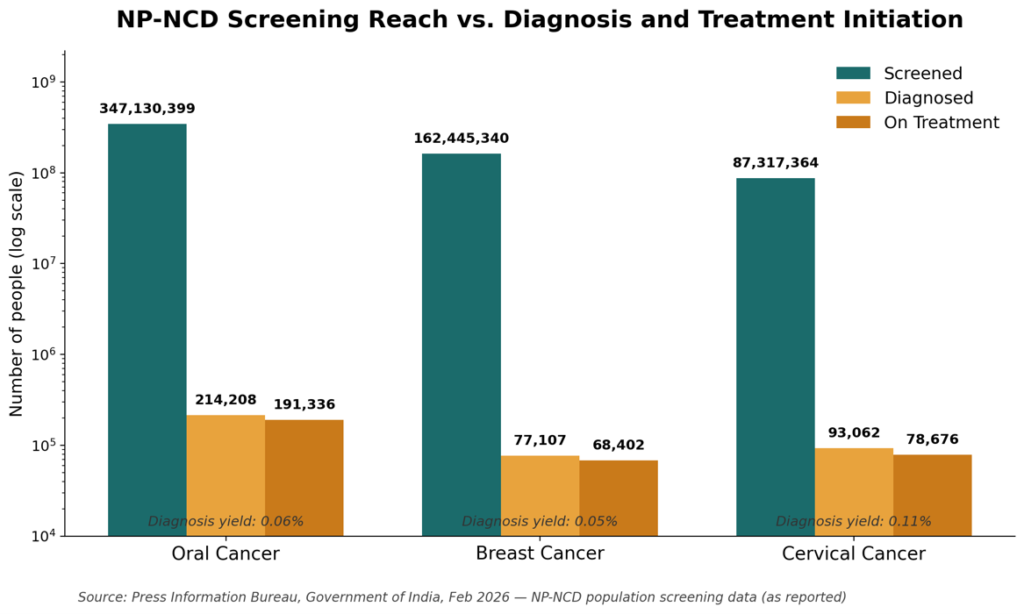
A particularly encouraging dimension of this programme is the sheer scale of population outreach achieved through screening. Government data reported as of February 2026 shows that more than 34.7 crore people have been screened for oral cancer, 16.2 crore for breast cancer, and 8.7 crore women for cervical cancer under NP-NCD screening coverage on a scale few health systems in the world attempt.
Figure 5 Adapted from PIB, Union Budget 2025-26 — cancer care initiatives. https://www.pib.gov.in/PressReleaseIframePage.aspx?PRID=2102729®=48&lang=2
Figure 6 Adapted from Press Information Bureau, Government of India. 8.73 Crore Women Screened for Cervical Cancer; 93,062 Cases Diagnosed Under NP-NCD (data as of February 2026).
Broader cancer policy has moved faster. Ayushman Bharat–PMJAY offers up to ₹5 lakh in annual health cover per family, with over 90% of registered cancer patients starting treatment under the scheme by 2024. The National Cancer Grid, spanning 287 institutions, now treats over 750,000 new patients a year — roughly 60% of India’s cancer burden. Rashtriya Arogya Nidhi adds up to ₹15 lakh for below-poverty-line patients through 27 Regional Cancer Centres, while the Tertiary Care Cancer Centres (TCCC) scheme has built out 19 State Cancer Institutes, 20 TCCCs and flagship centres in Jhajjar and Kolkata. The Union Budget 2025-26 adds 200 Day Care Cancer Centres and duty exemptions on 36 life-saving cancer drugs, alongside India’s entry into the Quad Cancer Moonshot and the launch of NexCAR19, its first indigenous CAR-T therapy.
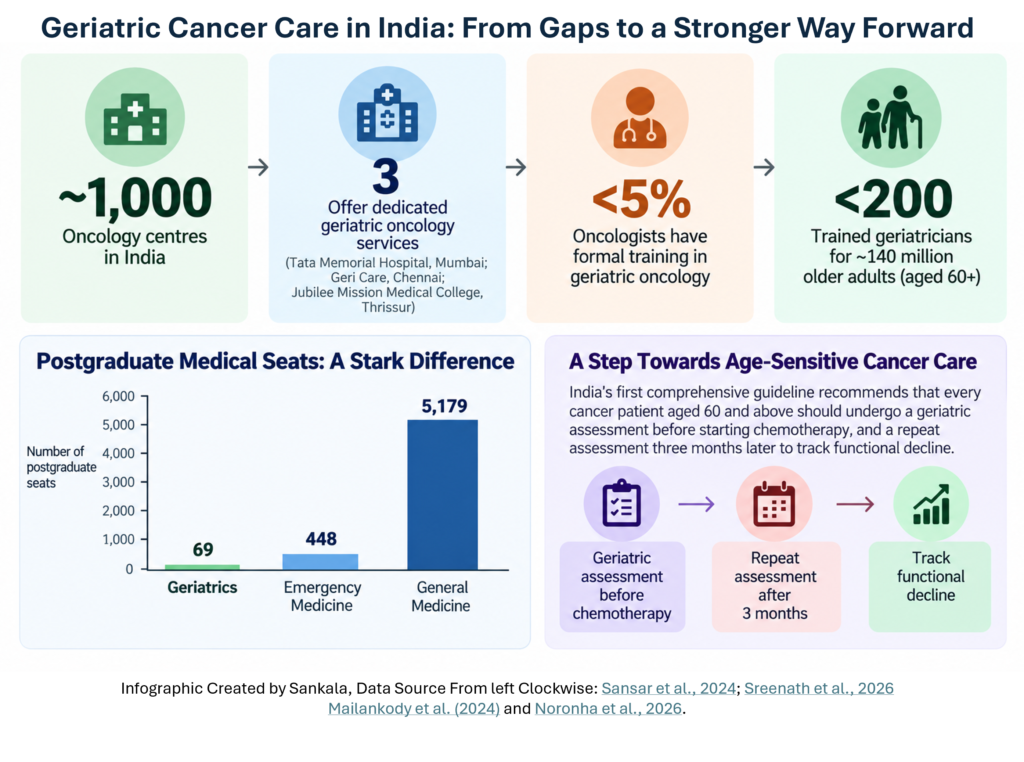
There are, however, signs of change. Indian oncologists and geriatricians, led by Tata Memorial Hospital in collaboration with AIIMS New Delhi and cancer centres nationwide, have released India’s first comprehensive guideline recommending that every cancer patient aged 60 and above should undergo a geriatric assessment before starting chemotherapy and to be repeated three months later to track functional decline.
This was reported in an Indian Express article, ‘Why 60-year-olds with the same cancer may need different’. As the guideline’s authors put it, older patients with cancer are not simply older versions of younger patients; they carry vulnerabilities, unrelated to the cancer itself, that shape how well they tolerate treatment and how they fare overall. That single insight captures what this data has been pointing to all along. India doesn’t just need more oncology beds it also needs an oncology system built for the elderly cancer patients.
Taken together, the policy landscape for cancer in India reflects a programme that has grown in ambition and reach with each successive phase from a 100-district pilot to a nationwide network of clinics, financial protection schemes, research infrastructure and partnerships. With quality assurance in screening and dedicated geriatric oncology capacity now emerging as two clear priorities for the next phase, India’s cancer-control programme is well positioned to build on a strong decade of expansion with an equally strong decade of refinement that reaches every age group of the population it serves.
International Institute for Population Sciences (IIPS) and NPHCE, MoHFW. Longitudinal Ageing Study in India (LASI), Wave 1, 2017-18, India Report. https://www.iipsindia.ac.in/lasi
The Indian Express. “With elderly cancer cases rising, India gets 60-plus therapy model” (guideline developed by Tata Memorial Hospital, Mumbai, with AIIMS New Delhi and partner cancer centres). Cited from the source article as provided; a stable public URL could not be independently verified at the time of writing.
Current Status of Implementation of Cancer Screening Programme in India: A Review of Policies and Practice (see also ref. 7); National Programme for Prevention and Control of Cancer, Diabetes, Cardiovascular Diseases and Stroke (NPCDCS)/NP-NCD operational guidelines, Ministry of Health and Family Welfare, Government of India (2013, 2016, 2018, 2023).
Meena, J.K., Yadav, K., Mehrotra, R. Implementing cancer prevention strategies in India: progress, persistent challenges and future directions. ecancermedicalscience, 2025;19:2042
Press Information Bureau, Government of India. 8.73 Crore Women Screened for Cervical Cancer; 93,062 Cases Diagnosed Under NP-NCD (data as of February 2026). Available at: pib.gov.in/PressReleasePage.aspx?PRID=2243768
Sansar B, Gupta A, Chitre A, Mishra BK, Lakshmanamurthy P, Gupta P, Sahoo A, Kaur N, Dey S, Vinayak KR, Kapoor A. At Crossroads: The Challenges for Geriatric Oncology in India. South Asian J Cancer. 2024 May 17;14(2):143-146. doi: 10.1055/s-0044-1786811. PMID: 41426151; PMCID: PMC12714431.
D. Sreenath, M. Shivarudraiah S, R. Govind, and K. M R, “ Enhancing Oncological Care for India’s Aging Population: Addressing the Complex Needs of Older Adults With Cancer.” Aging and Cancer 7, no. 1 (2026): 3–11. https://doi.org/10.1002/aac2.70011
Noronha, V., Rao, A., Pillai, A., Ramaswamy, A., Gota, V., Mailankody, S., et al. (2026). Guidelines for geriatric oncology in India: Recommendations for clinical practice (version 1).Journal of Geriatric Oncology, 17(7), 103038. https://doi.org/10.1016/j.jgo.2026.103038
Dr. Vaibhav Rastogi is a community physician and public health expert with over 14 years of experience. He holds an MD in Community Medicine and a Master's in Population Studies & Health Management. At Sankala Foundation, he leads public health research, digital health, and healthcare innovation. He previously supported child health programmes at the Ministry of Health & Family Welfare and managed projects backed by BMGF, WHO, USAID, and CDC.
Dr Simran Dutta is a public health professional specialising in digital health, health systems strengthening, and research. She holds a degree in Homoeopathic Medicine and a PGDM in Health Management from IIHMR, New Delhi. At Sankala Foundation, she contributes to research, policy analysis, and technology enabled solutions to improve healthcare access and outcomes.