



How Technology has Shaped India’s Tiger Recovery Programme

India’s tiger (Panthera tigris) conservation journey is widely regarded as one of the most remarkable wildlife recovery stories of the modern era. From the brink of extinction in the 20th century to a population exceeding 3,600 today, the efforts reflect ecological commitment, scientific innovation, and the transformative role of technology in wildlife protection.

A family of the Bengal Tiger in Corbett Tiger Reserve, India Photo Courtesy: T Narayan

In his writings and reflections on Project Tiger, Kailash Sankhala, he first director of Project Tiger, emphasised that protecting tigers requires preserving the entire ecosystem and habitat they depend upon vision of “complete protection” has evolved into a system where technology, science, and human vigilance work together to safeguard wildlife.
Today, wildlife protection extends far beyond traditional patrolling. Artificial intelligence, drones, satellite monitoring, forensic science, and digital patrol systems have become central to protecting India’s forests. Yet, technology alone does not define this transformation. At its core lies the dedication of forest guards, rangers, scientists, and local communities whose efforts translate conservation strategies into practice.

Global Scenario: Technology and the Transformation of Conservation

In Africa, drones equipped with thermal cameras patrol vast savannahs to detect poachers and monitor elephant and rhino movements. AI-enabled sensors provide real-time alerts when illegal activity is detected inside protected areas. In Russia’s Far East, satellite-linked collars and AI analytics track the movement of Amur tigers across immense snowbound landscapes. In Latin America, AI-powered camera systems are documenting jaguars in dense rainforests, generating critical data for corridor planning and indigenous-led conservation. The Spatial Monitoring and Reporting Tool (SMART) are another widely used innovation that helps rangers collect field data, monitor threats, and improve anti- poaching efforts. By strengthening patrol planning and decision-making, SMART has enhanced conservation outcomes across protected areas worldwide.
Globally, technology has become a force multiplier. It amplifies the effectiveness of traditional field protection, strengthens scientific credibility, and improves accountability in conservation management.
Yet, the global experience also reveals an important lesson: technology is not a substitute for fieldwork. It is most effective when combined with local knowledge, community participation, and strong enforcement systems.
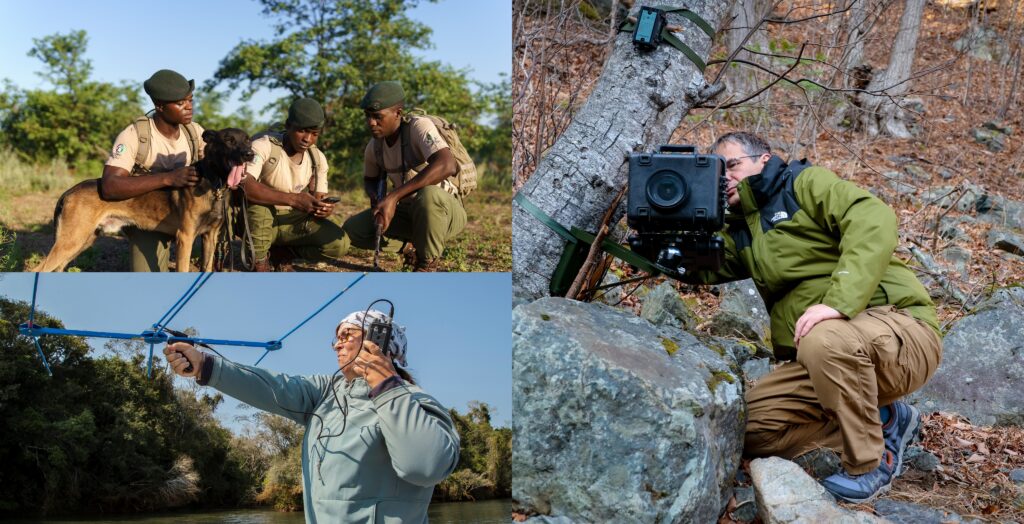
(Clockwise from Left): Dog Unit using SMART (Spatial Monitoring and Reporting Tool) in Zimbabwe (Photo Courtesy: Bad Rabbit Studios/GCT) Installing a camera trap in Zov Tigra National Park, home to a significant share of the world’s remaining wild Amur tigers. (Photo Courtesy: Sascha Fonseca) Tracking a radio-collared jaguar using Very High Frequency (VHF) telemetry in Iguaçu National Park (Photo Courtesy: Project Jaguars of Iguaçu)

India’s Tech-Leap in Tiger Conservation

Technology has become an important component of wildlife protection in India. Alongside traditionalbpatrolling, tiger reserves increasingly use satellite telemetry, drones, GIS mapping, artificial intelligence, and digital monitoring systems to strengthen conservation efforts.
These technologies help track wildlife movement, monitor habitat health, identify threats in real time, and support evidence-based management decisions. They have also improved patrolling efficiency and strengthened monitoring systems across tiger landscapes.

However, technology alone cannot secure wildlife habitats. The dedication of forest guards, rangers, scientists, and local communities working under difficult conditions remains central to wildlife
protection.

India’s tiger conservation strategy, therefore, combines technological innovation with field protection and scientific monitoring, contributing significantly to the recovery of tiger populations across several landscapes. Some of the tech interventions used are below:

E-Eye Surveillance and Real-Time Monitoring
One of the most transformative interventions in wildlife protection has been the E-Eye surveillance system. Using high-resolution cameras, thermal sensors, and command centres, the system enables real-time monitoring of forest boundaries, detection of illegal intrusions, and rapid response to poaching attempts and forest fires.
Introduced as a pilot project in Corbett Tiger Reserve in 2012, the E-Eye system significantly improved surveillance and response mechanisms by integrating technology with traditional patrolling. The initiative helped reduce illegal intrusions, strengthened proactive enforcement, and demonstrated how technology, when combined with the dedication of frontline forest staff, can create a more effective protection network for wildlife conservation.
Camera Traps and AI-Based Monitoring
Camera traps have revolutionised wildlife monitoring by offering unprecedented insight into the secret lives of tigers and their prey. Tigers are identified by their unique stripe patterns, enabling accurate population estimates using capture–recapture methods.

Artificial intelligence has further transformed this process. AI-enabled systems can automatically identify species, analyse behavioural patterns, and issue alerts when suspicious human activity is detected. What once required weeks of manual sorting can now be completed rapidly and with greater accuracy.

As conservationist Ullas Karanth emphasised, “Science-based monitoring is the backbone of credible conservation” (Karanth et al., 2003). AI transforms raw data into actionable intelligence, enabling conservation managers to anticipate threats rather than merely respond to them.

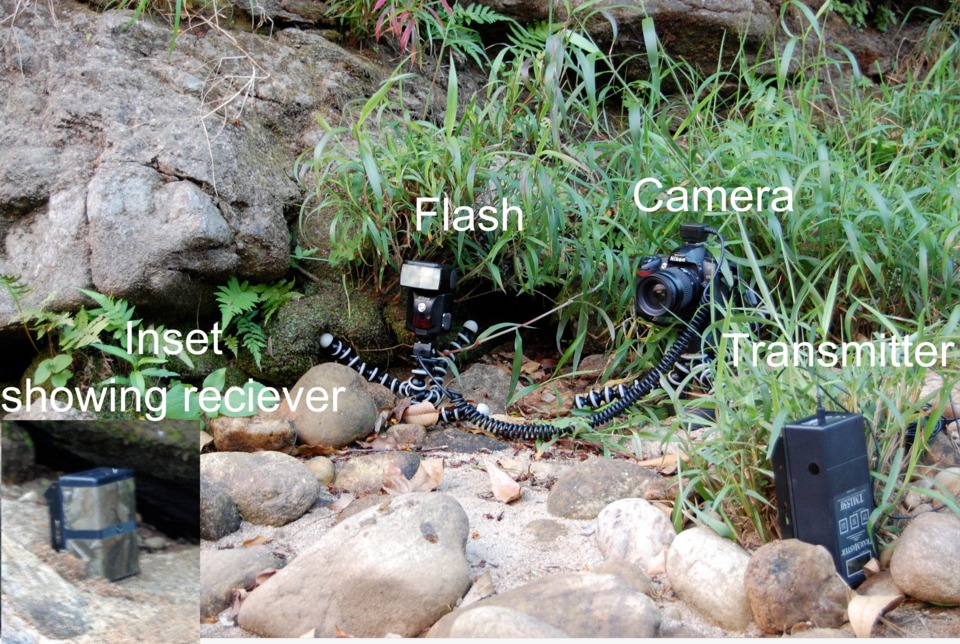
Camera trap used for photographing nocturnal wildlife Photo Courtesy: Prashanthns/Wikimedia Commons
Drones and Aerial Vigilance

Drones represent another frontier in wildlife protection. Equipped with thermal imaging systems, they assist in surveillance, monitor nocturnal movements, detect forest fires, and track tiger dispersal near villages to reduce human–wildlife conflict.

Drones also help with habitat mapping, monitoring invasive species spread, and studying waterhole dynamics. By extending the reach of frontline staff, they ensure that protection remains adaptive and vigilant.

M-STrIPES and Digital Patrolling

India has strengthened wildlife protection through M-Stripes (Monitoring System for Tigers – Intensive Protection and Ecological Status), a GPS-based monitoring system that records patrol routes, wildlife sightings, and illegal activities in real time. By generating spatial data for management decisions, it has improved accountability, strengthened patrol coverage, and made conservation more transparent and evidence-based.

Anti-Poaching Camps and Ground Protection

Despite technological advancements, ground protection remains central to wildlife conservation in India. Anti-poaching camps located deep inside forests and staffed round the clock continue to serve as important bases for surveillance and rapid response. These camps help monitor critical habitats, prevent illegal entry, and deter poaching.

Seasonal protection measures also play an important role. During the monsoon, forest accessibility becomes difficult and vulnerable areas require intensified patrolling. In several reserves, forest staff use elephants and boats in flooded areas and establish temporary camps to ensure that protection does not weaken during ecologically sensitive periods.

Together, these efforts reinforce the role of human vigilance alongside technology in India’s tiger conservation strategy.

Forensics, Sniffer Dogs, and Intelligence Networks

Modern conservation increasingly relies on forensic science. DNA analysis, tissue examination, and geographic tracing now strengthen prosecutions against wildlife criminals. Wildlife forensics bridges the gap between field detection and legal enforcement. As conservationist George Schaller has long emphasized through his work, “effective wildlife protection requires strong enforcement mechanisms”.

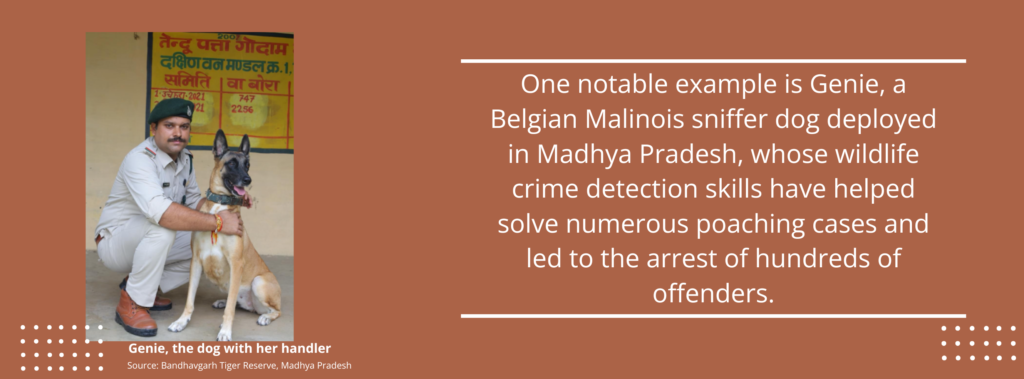
Specially trained sniffer dogs also play an important role in tracking poachers and detecting wildlife contraband. Programmes supported by organisations such as the Wildlife Trust of India have trained canine units that are now deployed across several tiger reserves. One notable example is Genie, a Belgian Malinois sniffer dog deployed in Madhya Pradesh, whose wildlife crime detection skills have helped solve numerous poaching cases and led to the arrest of hundreds of offenders.

Technology and forensic tools, however, cannot dismantle wildlife crime on their own. Informer networks, coordination with police agencies, and local intelligence gathering remain equally important components of India’s protection strategy. In several reserves, former hunters have been integrated into conservation efforts, transforming former adversaries into guardians of the forest. Their knowledge of forests, animal movement, and tracking methods has strengthened ground-level surveillance and protection.

Monitoring Mechanisms and Accountability

A defining strength of India’s tiger conservation model is its emphasis on evaluation and accountability. Protection is not treated as a static achievement but as a continuous process regularly assessed and improved through structured monitoring frameworks.

One of the key mechanisms is the Management Effectiveness Evaluation (MEE) framework, conducted periodically under the National Tiger Conservation Authority (NTCA). MEE assesses tiger reserves across multiple dimensions, including protection efficiency, habitat management, staff capacity, community engagement, and tourism regulation. The framework follows standardized protocols aligned with international conservation practices, ensuring that reserves are evaluated against both national and global benchmarks.

MEE helps identify strengths and gaps in reserve management, encourages the adoption of best practices, and strengthens accountability across the conservation system. By embedding evaluation into wildlife management, it ensures that protection measures continue to evolve and improve over time.

In addition to MEE, India has also instituted independent security audits to assess vulnerabilities in tiger reserves. These audits evaluate patrol coverage, communication systems, protection infrastructure, intelligence networks, and high-risk areas vulnerable to poaching and illegal activities.

Security audits have helped plug gaps in protection, strengthen enforcement strategies, and improve preparedness against emerging threats. Together, MEE and security audits create a system in which tiger reserves are not only protected but also continuously monitored against measurable performance standards.

This emphasis on evaluation and accountability has become an important component of India’s conservation approach, strengthening the credibility, adaptability, and long-term effectiveness of tiger protection efforts.

Prey Studies and Ecosystem Management

No tiger population can survive without an adequate prey base. India’s tiger conservation model therefore recognizes that predator protection is closely linked to prey monitoring and habitat management.

Scientific methods such as line transect surveys, camera traps, distance sampling, and habitat analysis are used to assess prey abundance and distribution across tiger landscapes. These studies help determine habitat carrying capacity, guide habitat restoration, and predict predator dispersal and potential conflict zones.

In Panna Tiger Reserve, improvements in prey density played a key role in the successful reintroduction of tigers. Prey studies also support broader management decisions related to grassland restoration, water availability, anti-grazing measures, and landscape connectivity, ensuring that conservation remains ecologically grounded.

Sambar deer standing among tall grass in Panna, India, showcasing its striking antlers Source: Shoyab Khan/Pexel

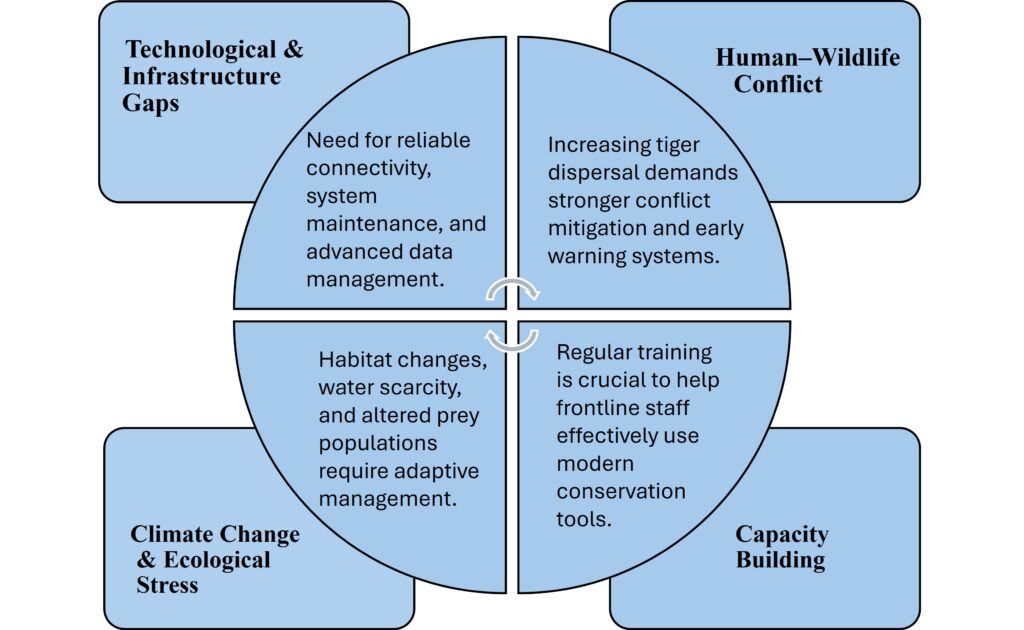
Challenges Ahead

Conclusion

Wildlife protection in India today reflects the integration of traditional tracking methods with modern science. From AI-powered monitoring systems and drone surveillance to forensic laboratories and GPS-enabled patrolling, conservation has evolved into a comprehensive and technology-driven enterprise.

Yet at the centre of this transformation stands the forest guard, walking silently through dense forests, often under dangerous, difficult conditions. Technology strengthens protection, but it is human dedication that sustains it on the ground.

The late conservationist Valmik Thapar consistently highlighted that protecting tigers means protecting the entire ecosystem they inhabit. India’s tiger conservation journey reflects this broader ecological vision, in which protecting tigers is inseparable from protecting forests, prey species, and natural habitats.

India’s tiger recovery story is therefore more than a species recovery in wildlife management. It is a story of ecological resilience, scientific innovation, and evolving conservation practices that combine technology, field protection, and community participation.

By protecting the tiger, India ultimately safeguards the ecological integrity of its forests while offering the world an important model of coexistence between people and the wild.

Reference

  • This blog is based on an original article written by Mr. Hemanth Kumar (IFS, Retd.). The views expressed are those of the author.
  • Data and insights are referenced from the article titled “Protecting Tigers in India: Technology, Tenacity, and the Transformation of Conservation.”
  • Read More: View Article

Author

  • Hemanth Kumar is a retired Indian Forest Service (IFS) officer and served as Principal Chief Conservator of Forests (PCCF), Uttar Pradesh. Currently, he is a special monitor, tribals at the National Human Rights Commission (NHRC).

    View all posts

Leave a comment

Your email address will not be published. Required fields are marked *

Cart (0 items)