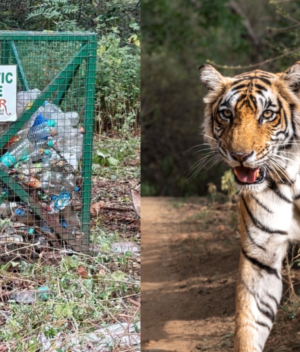
An ambush of tigers inside the Corbett Tiger Reserve, India. This habitat offers recreational, biodiversity, and watershed services
Photo Courtsey: Mayank Jaiswal
From the tiger landscapes of countries like India and Nepal to the snow leopard ranges of the Himalayas, the lion savannahs of Africa and the leopard forests of Southeast Asia, every big cat thrives in a vast, functioning landscape. These habitats not only support the apex predators in maintaining the ecological balance but also pose as ultimate economic engines, storing precious carbon, anchoring river systems that quench downstream mega-cities, boosting tourism and acting as biological shields against planetary instability. Economists today label these beneficial roles as ‘ecosystem services. They estimate that these services, provided by nature, far exceed the economic value of the world’s GDP!
Ecosystem services are benefits that flow directly from nature and contribute to human welfare. Across 95 big cat range countries, while these landscapes (enriched with deep forests, grasslands and wetlands) generate ecosystem services that are valuable natural assets, or natural capital, this contribution to economies is rarely recognised or rewarded. Most of these services are not traded in conventional markets even though the benefits they generate extends far beyond the landscape themselves. By filtering water and trapping carbon, healthy ecosystems create value worth trillions of dollars. But the modern financial world lacks the institutions, funding pipelines and governance structures capable of transforming these services into steady revenue.
Today there is an urgent need to mobilise resources to promote conservation of big cats’ habitats and to treat such conservation as climate action. Bhutan has shown remarkable success in operationalising the ecosystem services model. It has integrated ecological value directly into its national governance, economic policies, and constitutional laws. In Bhutan, nature is not a resource to exploit for GDP but a foundation for Gross National Happiness (GNH) of the people. Research indicates that Bhutan’s total ecosystem services generate an estimated US$15.5 billion annually—nearly five times the nation’s financial GDP.
Climate regulation, water security, and biodiversity conservation are public goods that benefit society at large. We need to consider them as the real ‘gold’, enriching our planet and supporting millions of species. How do we identify the ‘green’ gold in the landscape?
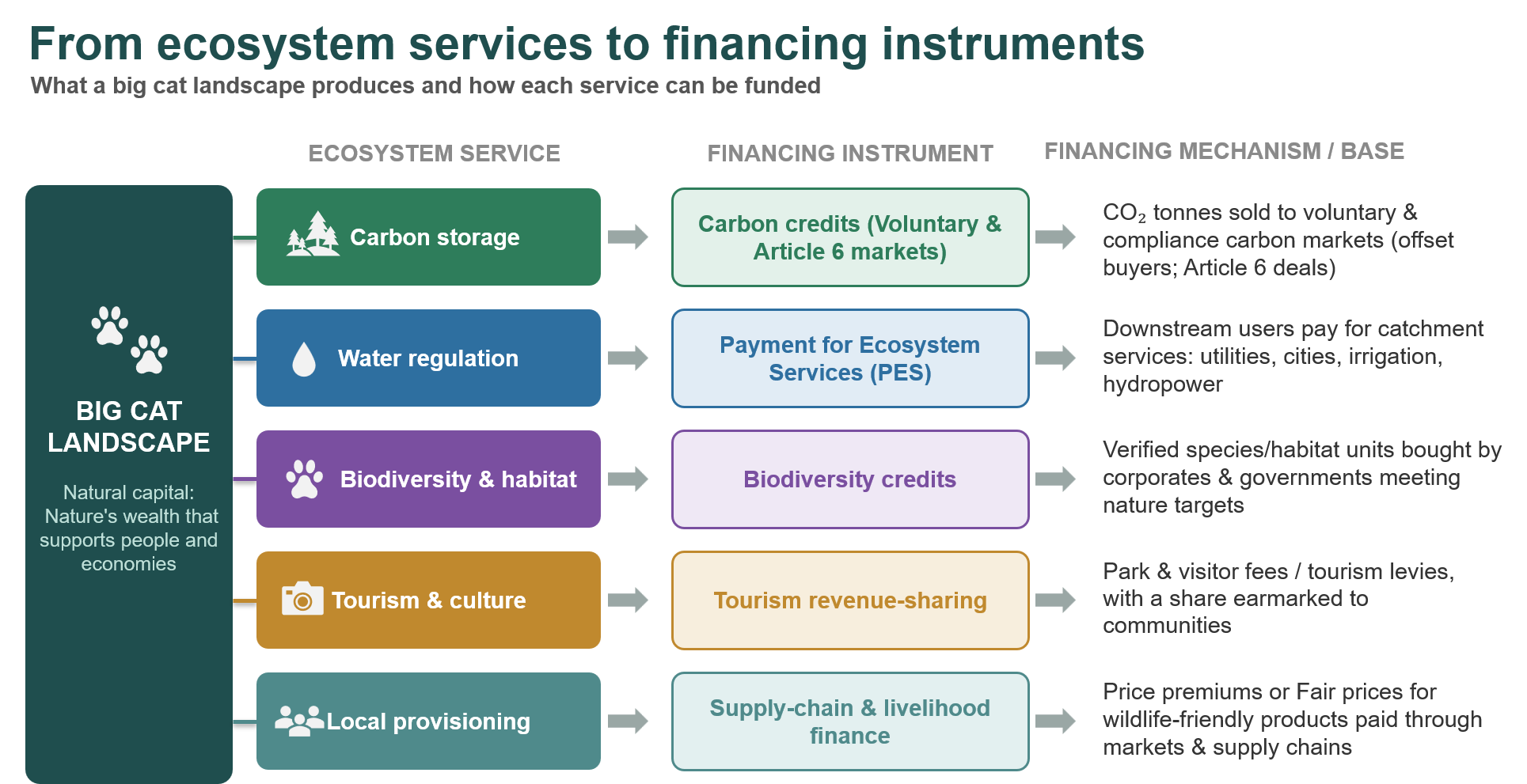
The starting point could be a simple question: what does this landscape provide, who benefits, and who might be willing to pay for such ecosystem services? For big cat landscapes, four-five ecosystem services account for much of their measurable economic value, and each aligns with a distinct financing pathway. The infographic maps each ecosystem service with a pathway, providing a practical framework for matching ecosystem services with appropriate financing instruments.
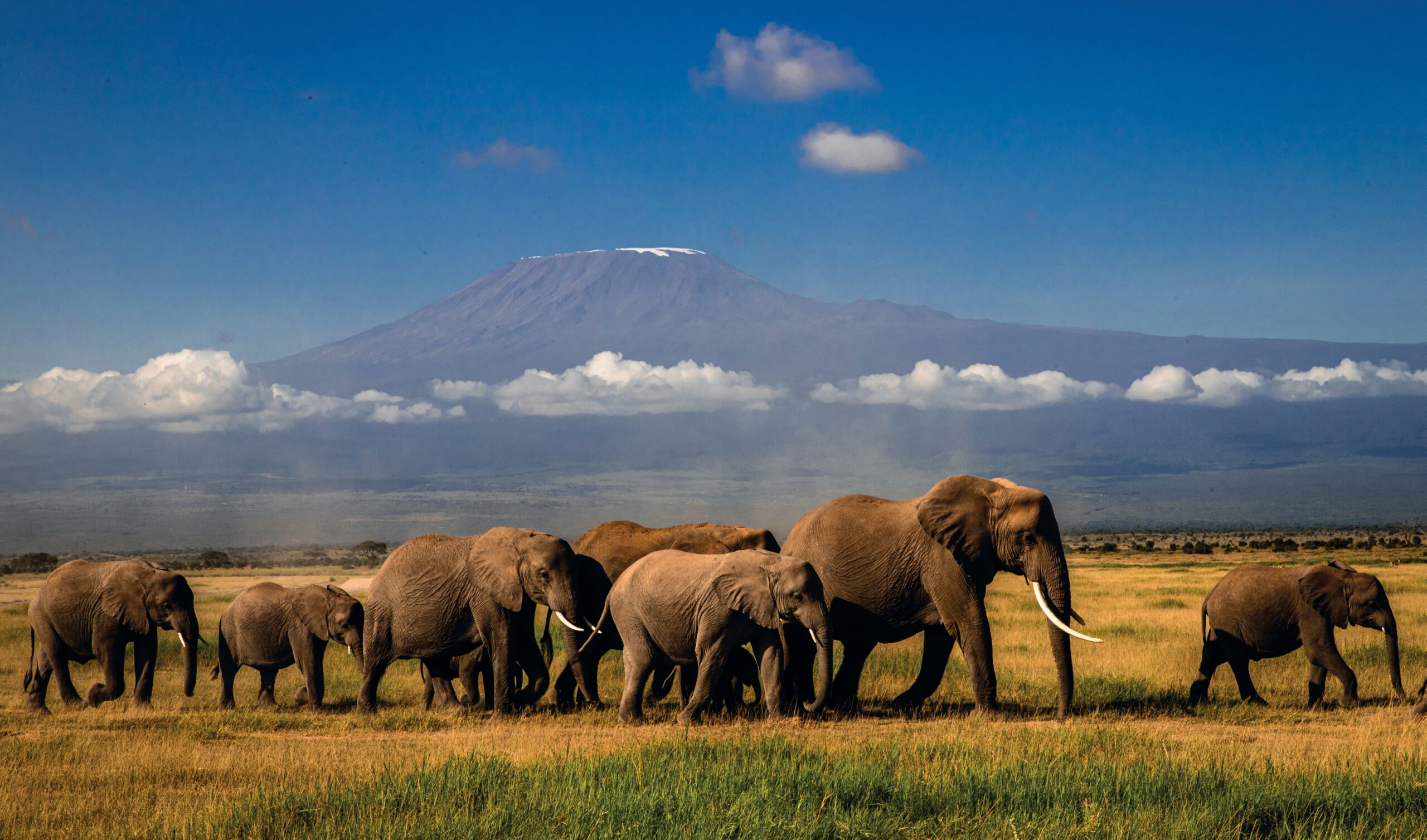
Ambosali National Park Kenya: Set in the backdrop of the iconic, snow-capped Mount Kilimanjaro, Amboseli’s open plains offer a rich landscape to renowned large elephant tuskers and big cats like lions and cheetahs and several pastoral communties. Large herbivores like the elephants act as ‘ecosystem engineers’ by consuming vegetation and accelerating seed dispersal. The park’s freshwater swamps are a critical, year-round water source for several wild animals
Photo Courtsey: Gobind Bhardwaj
Big CatLandscape Finance in Action
Bhutan Trust Fund for Environment Conservation (BTFEC):
One of the world's first conservation trust funds with an endowment of about US$84 million, providing sustained, independently governed financing for tiger and snow-leopard landscapes.
» Cambodia (Keo Seima):
A REDD+ forest-carbon project preventing around 1.4 million tonnes of CO₂ annually, channeling over US$1 million to 20 Indigenous Bunong communities through verified benefit-sharing.
Namibia (Community conservancies):
Namibia's Community-based Natural Resource Management model spans 86 communal conservancies covering some 180,000 km² generating tourism and wildlife revenues that give communities a direct economic stake in conserving lion and cheetah landscapes.
Zambia (Community Markets for Conservation (COMACO & Tondwa):
COMACO pays premium prices to over 200,000 farmers for wildlife-friendly produce in the Luangwa lion landscape, while the nearby Tondwa pilot is testing biodiversity credits in a key lion corridor.
Identifying key ecosystem services is not merely an academic exercise. It is the evidence base for designing the right financing mechanisms and investments. When a forest pays for itself, conservation stops being a continual cost and becomes a sound investment. In India, detailed valuations of tiger reserves found that freshwater provisioning is often the single largest economic benefit, with some reserves supplying water-regulation benefits valued over US$730.3 million annually. Adding carbon storage, biodiversity and tourism further highlight the significant economic value of these landscapes as productive natural assets. Such evidence provides a compelling economic rationale for cities, industries, utilities and other downstream beneficiaries to contribute towards conserving the forests and watersheds on which they depend.
Carbon Credits, Bedrock of Conservation
Carbon credits are currently the bedrock of landscape conservation. By protecting carbon-rich forests, nations avoid deforestation and turn forests into tradable assets. Countries and communities can generate verified carbon credits that are purchased by governments or companies seeking to meet their climate commitments. The Reducing Emission from Deforestation and Forest Degradation (REDD+) provides the principal framework for developing forest carbon projects, while voluntary carbon markets provide the most established route for trading these credits. Independent standards such as Verra’s Verified Carbon Standard and the Climate, Community and Biodiversity Standards help ensure environmental integrity and community benefits.
An important new opportunity has emerged through Article 6.2 of the Paris Agreement, which allows countries to transfer verified emission reductions directly to other countries towards meeting their climate commitments. Unlike voluntary carbon markets, these sovereign transactions can command higher prices, with revenues flowing to governments rather than individual project developers. Realising these benefits, however, depends on transparent governance and effective benefit-sharing arrangements that ensure revenues reach the landscapes and communities responsible for delivering conservation outcomes.
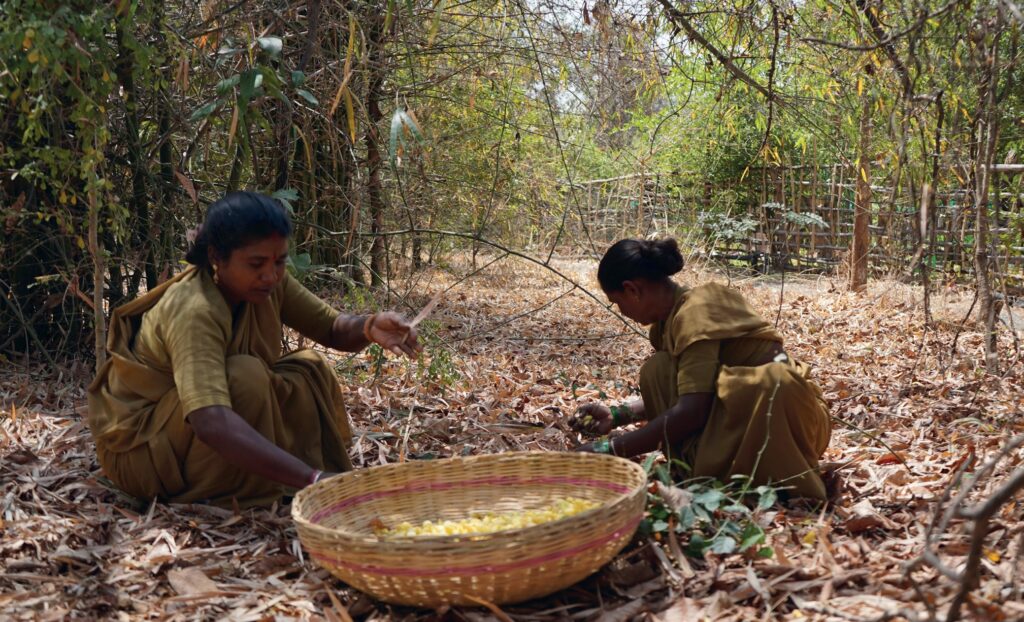
Women collect Mahua tree flowers in the buffer zone of Ranthambore Tiger Reserve, India. Every part of the tree-flowers, seeds, bark, leaves and oil – is valued by the community
Photo Courtsey: Rhea Verma
Success also relies on Free, Prior, and Informed Consent (FPIC). Well-designed carbon projects, built on FPIC of local communities, can strengthen community stewardship, secure land rights and support sustainable livelihoods, creating a foundation for complementary financing mechanisms. Cambodia’s Keo Seima Wildlife Sanctuary demonstrates this. The project prevents around 1.4 million tonnes of carbon dioxide emissions annually while generating over US$1 million for twenty Indigenous Bunong communities through verified benefit sharing.
Biodiversity credits reward tangible improvements in species and ecosystem health. Big cats are the ultimate bio-indicators. Their presence proves that an ecosystem is functioning. Although the market is still evolving, growing global interest in nature finance presents new opportunities for big cat landscapes. Establishing credible ecological baselines today will therefore be critical for accessing these opportunities as markets mature. Many protected areas may not have the institutional capacity to engage directly with international buyers or manage multiple financing streams. Conservation Asset Trusts and similar fiduciary institutions can help bridge this gap by pooling revenues across landscapes, ensuring transparent governance, and providing long term financial stewardship. The Madagascar’s Foundation pour les Aires Protégées et la Biodiversité de Madagascar (FAPBM) demonstrates how independent institutions with protected endowments can sustain conservation investments across political transitions.
How to Ensure Support For Big Cat Habitats
New approaches are moving beyond financing individual projects towards securing sustained support for entire landscapes. The Bhutan for Life initiative is one such example. It established a time bound transition fund for the country’s protected area network, releasing finance only after agreed conservation milestones are achieved. The result is predictable funding for tiger and snow leopard habitats that is less dependent on annual budgets or shifting donor priorities.
No single instrument is sufficient to finance a large conservation landscape over the long term. A more resilient approach is to combine, or stack, multiple instruments within the same landscape, bringing together carbon, water, biodiversity and tourism revenues to diversify income and reduce exposure to market volatility, policy shifts and changing buyer preferences. Sequencing matters as much such as tourism revenue sharing and voluntary carbon can generate early cash flows while the monitoring systems, institutional capacity and community institutions needed for more sophisticated mechanisms are built over time.
Source: Authors’ interpretation of ecosystem services and financing instruments
Finance alone, however, cannot secure lasting conservation outcomes. Its success ultimately depends on the institutions and governance that underpin it. Benefit sharing must be legally mandated, transparent and insulated from arbitrary administrative decisions so that communities living alongside big cats get a fair share in the benefits. Institutions managing conservation funds need the independence and protected endowments to persist beyond political cycles. Increasingly, financial disbursements are also being linked to verified ecological outcomes, reinforcing accountability and measurable conservation performance.
Recent experience shows why these conditions matter. Nepal’s remarkable success in nearly tripling its wild tiger population has also brought rising human wildlife conflict and renewed questions about whether local communities are getting adequate share. Conservation outcomes lasts only when communities living alongside wildlife see tangible benefits from protecting it. Weak market integrity, double counting across financing instruments and the capture of benefits by a powerful few remain real risks that require robust governance.
Ultimately, conservation finance protects big cats by financing the landscapes on which they depend. It supports foresters in the field, restores wildlife corridors, secures prey habitats and reduces conflict between people and wildlife. When landscapes generate reliable and sustained returns from the ecosystem services they provide, conservation becomes a shared investment in water security, climate resilience, livelihoods and biodiversity rather than a recurring cost borne by a few.
There is a wonderful opportunity for organisations like International Big Cat Alliance (IBCA) to help member countries identify ecosystem services, develop financing pathways suited to their ecological and institutional contexts, and strengthen the governance needed to manage them. The IBCA member countries span an extraordinary range of natural capital endowments, institutional capacities, income levels, and governance contexts. According to the World Bank, the Gross National Income per capita ranges from approximately US$ 400 in the lowest-income member countries to over US$ 14,000 in the highest; more than half are low or lower-middle income countries six are classified as Fragile and Conflict-affected States; and 42% are from the African continent.
A single financing model will not suit every country, but a common principle does: conservation is most durable when the people and institutions that protect big cat landscapes also share in the value they create. It is critical to strengthen ecosystem service identification, align financing instruments with country contexts, build credible governance systems, and ensure equitable benefit-sharing mechanisms.
Dr Robert Costanza is a renowned ecological economist and Professor of Ecological Economics at the Institute for Global Prosperity (IGP), University College London (UCL). He is a pioneer in valuing nature and ecosystem services, best known for his landmark research on the economic value of the world’s ecosystems and natural capital. He is the 2024 recipient of the Blue Planet Prize and has authored more than 600 scientific papers and 30 books. His work continues to advance innovative approaches to sustainable development, biodiversity conservation, and the economic value of nature.
Dr Madhu Verma is the Senior Economic Adviser and Chief Environmental Economist at Iora Ecological Solutions, New Delhi. She is an environmental economist with extensive expertise in natural capital, ecosystem valuation, biodiversity, and conservation finance. Her work focuses on demonstrating the economic value of ecosystems and integrating nature’s value into policy and sustainable development.