


El Niño: Understanding the Enigma in Times of Climate Change

New climate records are set with each passing year. Summers appear to burn more, heatwaves last longer, and extreme weather-from intense rainfall to prolonged droughts-has become increasingly common across the globe. 2024 was officially the warmest year ever recorded globally, with droughts, floods, heatwaves, and wildfires affecting millions of people. As these extremes become more frequent, one weather phenomenon appears to make constant headlines – El Niño. Extreme heat and heavy rain are both attributed to it. But is El Niño really the villain behind today’s extreme weather, or is it simply acting on an already warming planet? The answer begins with understanding the ENSO, one of Earth’s most influential natural climate systems. 

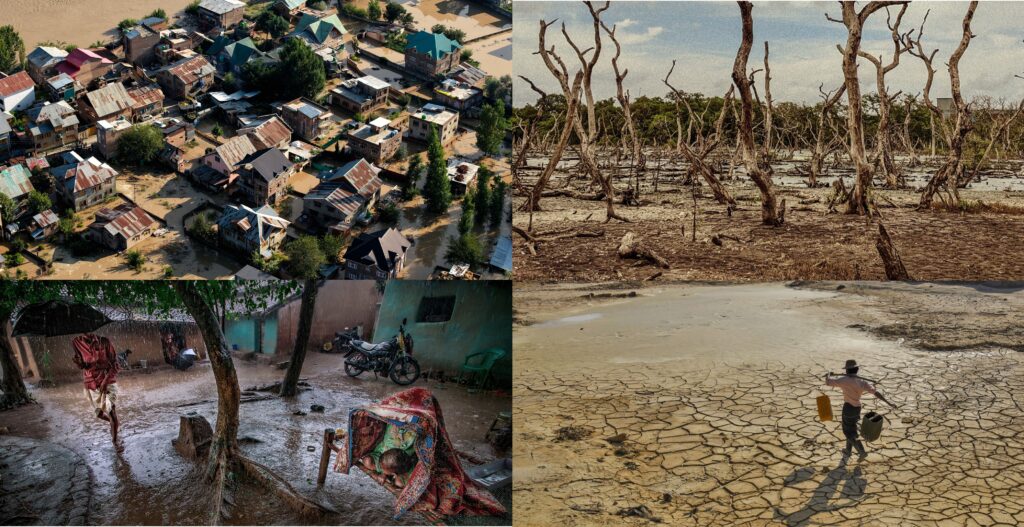
Figure 1. Clockwise from Left:  Drone captures devastating flooding in a rural village in Kashmir. (Photo courtesy: Imad Clicks/Pexel)
A barren landscape with withered trees under an, overcast sky in Kerala, India. (Photo courtesy: Sachin Sunil/Pexel)
A man carries water across a parched landscape in Sagaing, revealing drought impact in Myanmar (Photo courtesy:Pyae Phyo Aung/Pexel) A vibrant scene capturing monsoon rains in a rural village courtyard in Purulia, India (Photo courtesy: Sourav Das/Pexel)

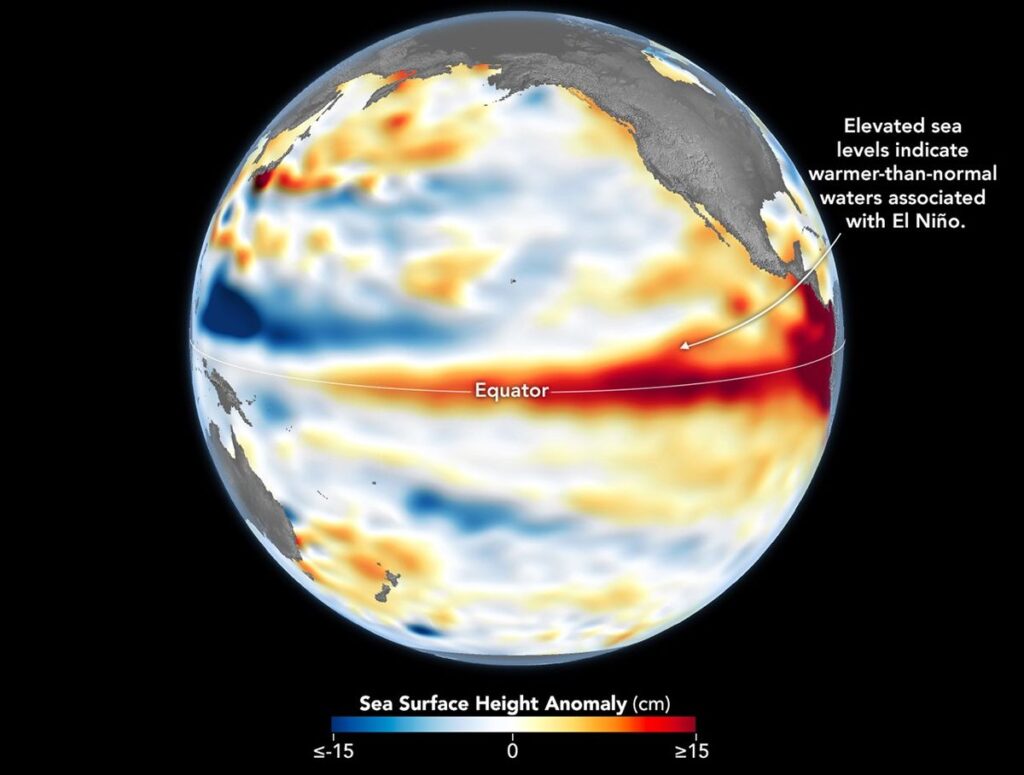
ENSO is the most prominent source of natural climate variability on earth. It involves periodic warming (El Niño) and cooling (La Niña) of sea surface temperatures in the central and eastern tropical Pacific Ocean and affects weather patterns across the globe, influencing monsoons, droughts, floods, tropical cyclones, agriculture and ecosystems. ENSO is a natural climatic cycle, but scientists have observed its effects getting increasingly intense in recent decades. This has prompted an essential question: Is climate change impacting ENSO, or is ENSO just playing out on an already warmer planet?

ENSO over the Last 30 Years

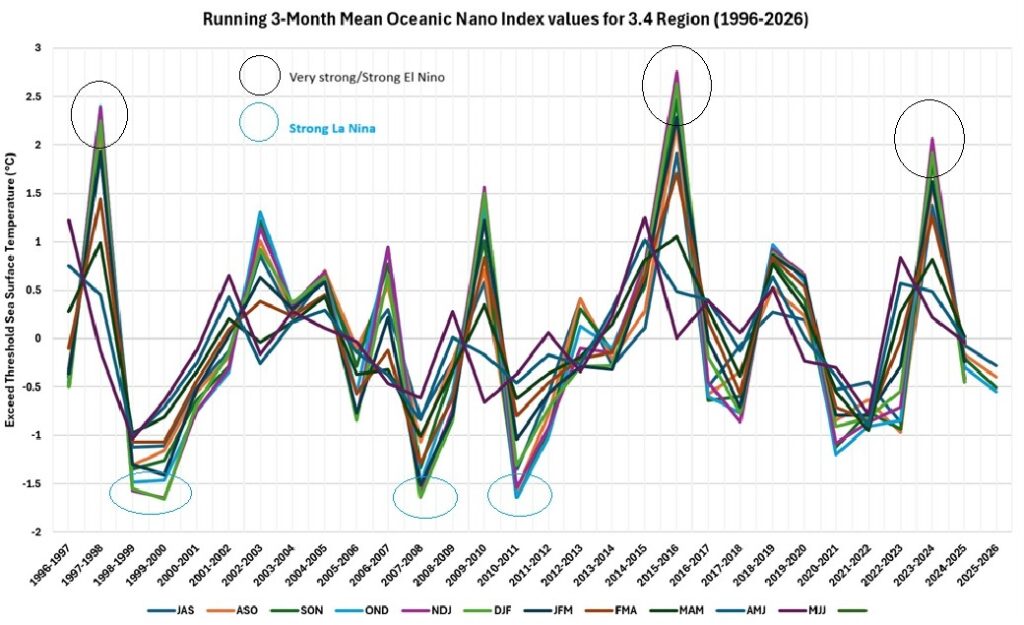
Over the last 30 years, scientists have observed some remarkable changes in the behaviour of ENSO with the temperature going above normal by +2.0°C to +2.5°C making strong to very strong El Niño conditions (Figure 3). The interaction between ENSO and human-induced climate change has become a subject of intense scientific investigation. In the last three decades, El Niño and La Niña have not become significantly more frequent. However, their impacts are becoming more noticeable because they now occur in a warmer climate, making heatwaves, heavy rainfall, floods, and droughts more intense. The very strong El Niño of 2015-16 contributed to record-breaking global temperatures. By the time another strong El Niño developed in 2023-24, the Earth had already become much warmer due to climate change, making its impacts even more pronounced. Understanding how ENSO has evolved over the last three decades naturally raises another question: What is happening now, and what can we expect in 2026?

Understanding ENSO in a Changing Climate

As the oceans and atmosphere continue to warm, El Niño and La Niña events occur against a much warmer climate. This means their impacts can become more intense. A strong El Niño today is more likely to contribute to record-breaking temperatures, severe heatwaves, extreme rainfall, droughts and wildfires than a similar event would have several decades ago.

Therefore, the relationship is best characterized as a one-directional amplification: ENSO does not cause climate change, but climate change can change ENSO behaviour and amplify its impacts (NOAA 2023). South Asia is among the region’s most sensitive to these changes because ENSO has a strong influence on the summer monsoon. Variations in monsoon rainfall directly affect agriculture, water resources, food security and the livelihoods of millions of people across the region.

Impact of ENSO 2026 in India

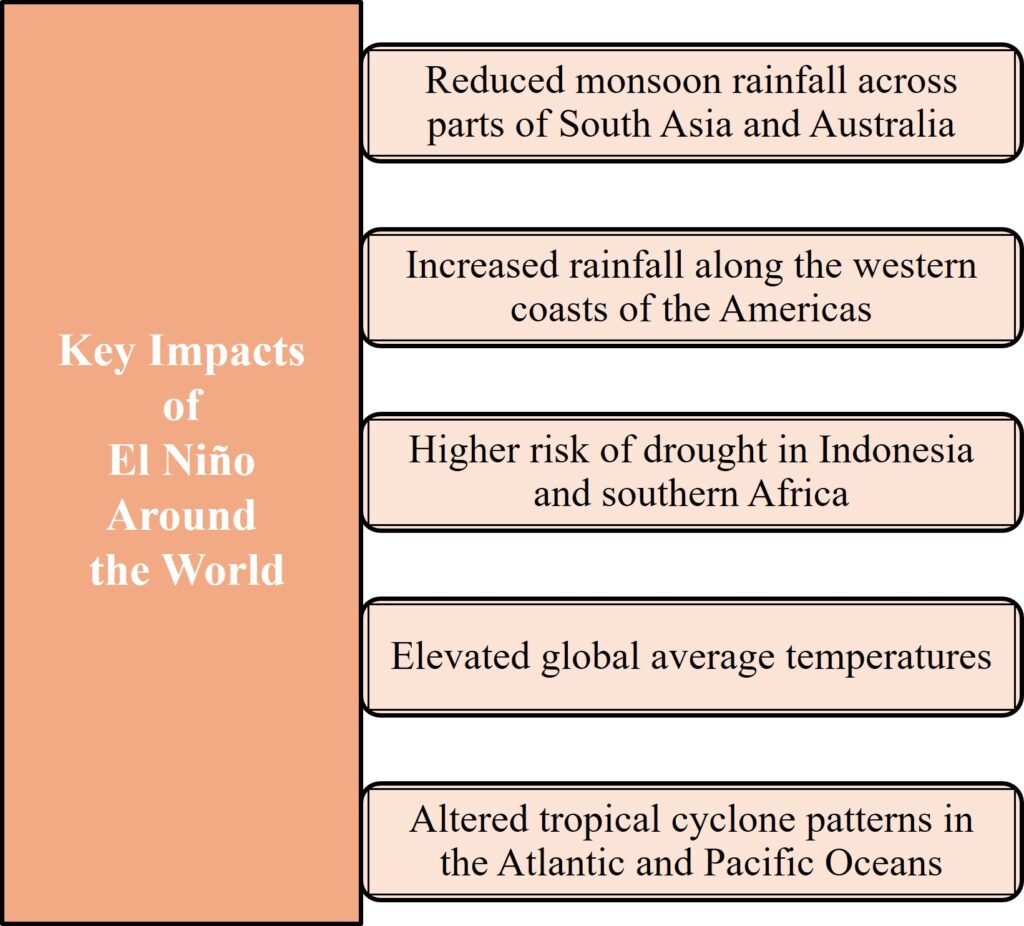
The developing El Niño conditions in 2026 have the potential to impact India’s southwest monsoon, but the impacts will depend on interactions with other climate drivers such as the Indian Ocean Dipole (IOD), a natural warming and cooling pattern in the Indian Ocean, and the Madden-Julian Oscillation (MJO), a moving weather system that influences tropical rainfall, which can either weaken or strengthen El Niño’s influence on the Indian monsoon. The delayed arrival of monsoon in Delhi this year is one such example. First time since 2021, monsoon arrived in July in the National Capital Territory of Delhi (on 2 July).  Historically, around 60% of the El Nino years have been associated with below average monsoon rainfall which causes short-term droughts, inadequate rainfall, and late monsoon arrivals. These conditions threaten Kharif crop yields, raise food prices, and lower rural incomes. The inadequate rainfall may also affect the reservoir replenishment, and groundwater recharge impacting water security, hydroelectric power generation and irrigation capacity.

Conclusion

While we cannot avert El Niño, we can mitigate its effects. Improvements in satellite data, climate modelling, and early warning systems now enable governments and communities to prepare months ahead. In a warming world, comprehending ENSO is no more merely a scientific task; it is imperative for safeguarding lives, livelihoods, and ecosystems.

References

  1. https://www.carboncopy.info/india-faces-severe-water-and-food-security-risks-with-approaching-el-nino
  2. IPCC (2023). AR6 Synthesis Report Climate Change 2023 https://www.ipcc.ch/report/ar6/syr/downloads/report/IPCC_AR6_SYR_LongerReport.pdf
  3. IPCC AR6 Working Group I (2021). Climate Change 2021: The Physical Science Basis. Cambridge University Press.
  4. Jiang, N., Zhu, C., McPhaden, M. J., Hu, Z. Z., Lian, T., Zhou, C., & Chen, D. (2025). Atypical warming pattern of strong 2023-24 El Niño boosts global temperatures to new 1.5° C record. Communications Earth & Environment, 6(1), 1012.
  5. NASA Jet Propulsion Laboratory (JPL) https://science.nasa.gov/earth/earth-observatory/el-nino-is-underway/
  6. NOAA (2023). https://www.climate.gov/news-features/blogs/enso/has-climate-change-already-affected-enso
  7. NOAA Climate Prediction Center. Oceanic Niño Index (ONI) v5. Available at: https://origin.cpc.ncep.noaa.gov/products/analysis_monitoring/ensostuff/ONI_v5.php
  8. NOAA Coral Reef Watch https://coralreefwatch.noaa.gov/product/5km/index_5km_ssta.php
  9. NOAA National Weather Service (NWS) https://www.weather.gov/lox/elnino
  10. Nyenzi, B., & Lefale, P. F. (2006). El Nino southern oscillation (ENSO) and global warming. Advances in Geosciences, 6, 95-101.
  11. World Meteorological Organization (2026). El Niño/La Niña Update – May 2026. Available at: https://wmo.int/resources/publication-series/el-ninola-nina-updates/el-ninola-nina-update-may-2026
  12. Wu, P. H., Lin, C. H., Chen, H., Wang, L., & Ho, C. R. (2025). Spatiotemporal Variations and Characteristics of the El Niño–Southern Oscillation (ENSO) Phenomenon from 1950 to 2023. Atmosphere, 16(11), 1264.

Author

  • Dr Prakash Biswakarma is a geoscientist and remote sensing professional working at the intersection of climate change, disaster risk reduction (DRR), and geohazard assessment. At Sankala Foundation, he brings extensive experience in applied earth system science and DRR using space-based technologies. He holds a Ph.D. in Landslide Studies from Guru Gobind Singh Indraprastha University, New Delhi.

    View all posts

Leave a comment

Your email address will not be published. Required fields are marked *

Cart (0 items)