The Silent Epidemic: Why Mental Health Must Become a Public Health Priority in India
Dr Vaibhav Rastogi
Dr Simran Dutta
Mental Health Beyond the Individual: A Global Development Challenge
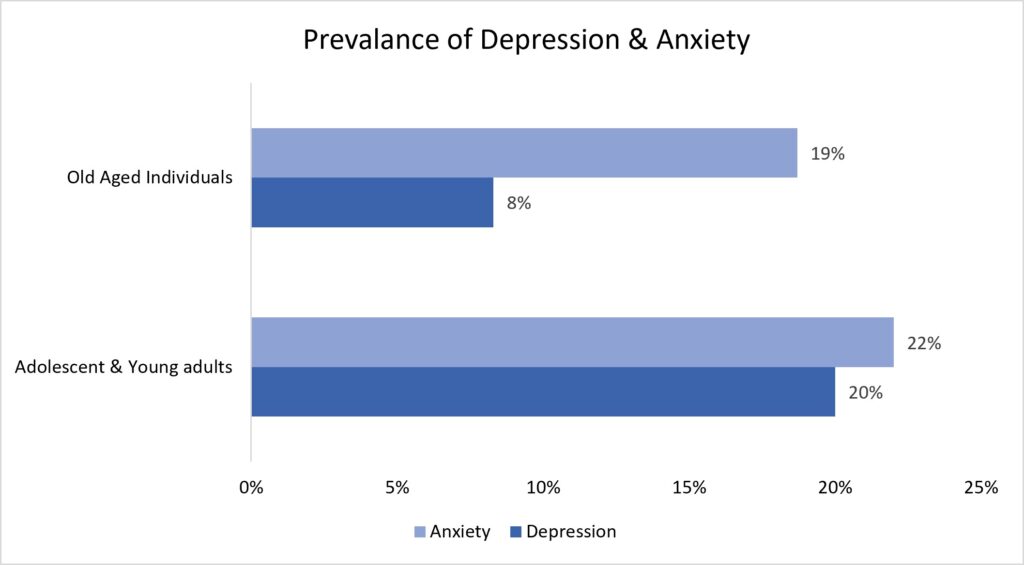
Behind every statistic on mental health is a child struggling to learn, a young adult navigating uncertainty, a professional experiencing burnout, or an older person facing loneliness and declining health. Over 30% of older adults (60 and above) in India report depressive symptoms. A large number live with dementia. Scientific surveys have helped us infer certain realities about the aged: There is a rise in nuclear families that has resulted in greater number of elderly living alone, without the support of their children. When young people migrate, the elderly are left alone. They are more vulnerable to loneliness, depression, abuse and isolation. According to UNICEF’s State of the World’s Children 2021, mental health touches every stage of life, influencing not only individual well-being but also the strength of families, communities, and economies. According to the World Health Organization’s World Mental Health Report (2022), nearly one in eight people globally lives with a mental health condition. It remains one of the most overlooked public health priorities of the current decade.
India’s Growing Mental Health Burden
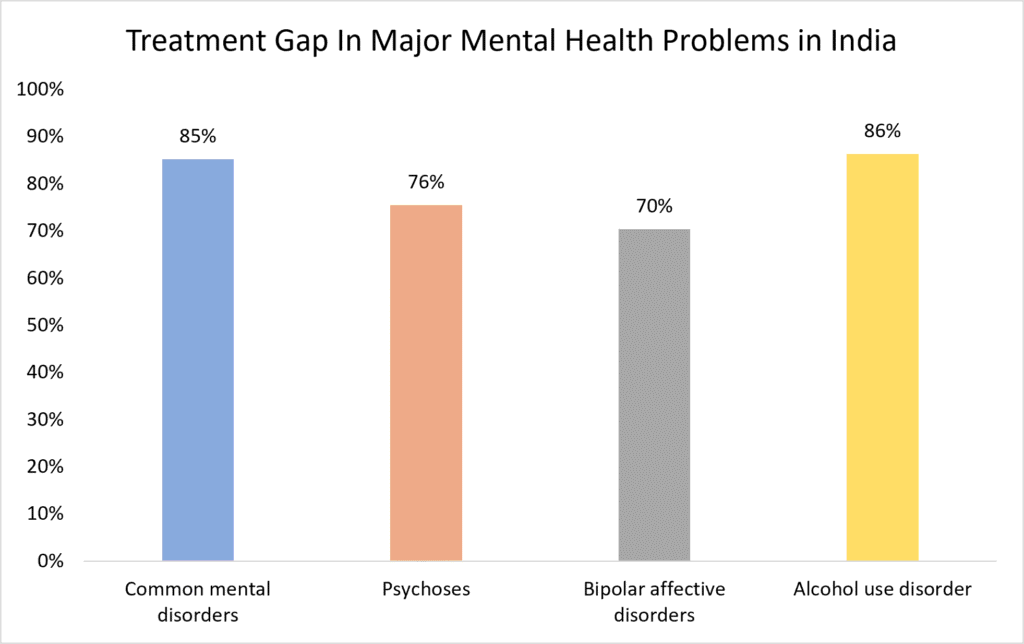
Behind India’s rapid social and economic transformation lies a silent mental health crisis. Mental health conditions contribute approximately 2,443 DALYs per 100,000 population and are accompanied by a suicide rate of 21.1 per 100,000 population, higher than the global average, as per the World Health Organization (India). The mental health crisis in India is driven by a complex interplay of socio-economic pressures, chronic stress, sedentary lifestyle, and ageing. Yet, for millions of Indians, access to treatment and appropriate care remains a challenge.
Mental well-being is essential for healthy ageing, independence, and
quality of life.
People Living with Severe Mental Illness
What the data says
According to the
National Mental Health Survey of India (2015–16)
,
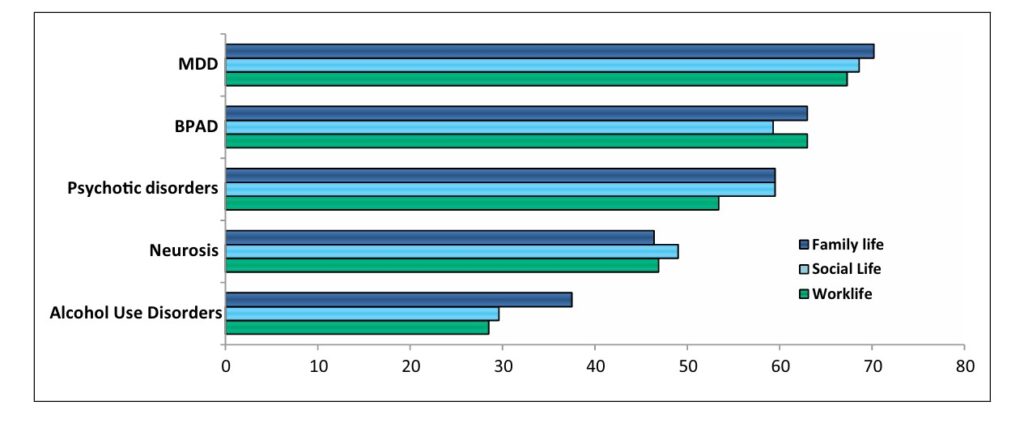
3 in 4 individuals with severe mental disorders
experience significant disability affecting work, relationships and
daily functioning.
Why it matters
The burden extends beyond individuals to families and caregivers,
impacting social and economic well-being.
India's Economy
What the data says
According to the
World Health Organization
,
mental health conditions are projected to cost
over USD 1 trillion between
2012–2030.
Why it matters
Mental health is both a healthcare priority and an economic
development imperative.
Mental health is a silent epidemic affecting every stage of life—from young people entering adulthood to older adults navigating healthy ageing. Its impact extends beyond healthcare, influencing education, workforce productivity, family well-being, and India’s economic development.
India’s Response to Building a Stronger Mental Health Ecosystem
Policy Initiatives: India has laid a strong foundation through initiatives such as the
Mental Healthcare Act 2017, the National Mental Health Programme, and Tele-MANAS,
led by the Ministry of Health and Family Welfare.
As highlighted in the World Health Organization’s World Mental Health Report (2022) and discussed by
Mahapatra, P., & Seshadri, S. (2024)
,
the next step is to integrate mental health across primary healthcare, schools, workplaces, and healthy ageing programmes,
while strengthening the mental health workforce and expanding equitable access in underserved regions.
47 Postgraduate Departments in mental health have been established or upgraded in 19 government medical colleges.
Services are also being introduced in 22 newly established AIIMS.
47 Government-run mental hospitals, including three Central Mental Health Institutions:
National Institute of Mental Health and Neurosciences (NIMHANS), Bengaluru
Lokopriya Gopinath Bordoloi Regional Institute of Mental Health, Tezpur
Central Institute of Psychiatry, Ranchi
Integration of mental health services into Ayushman Bharat – Health & Wellness Centres (HWCs).
Digital Innovation: Digital platforms such as Tele-MANAS demonstrate how technology can bridge treatment gaps.
Expanding tele-mental health, digital screening tools, and integrated referral systems can make care more accessible,
responsive, and people-centred, in line with the
World Mental Health Report (2022)
.
The World Health Organization has recognised Tele-MANAS as an innovative model,
responding to more than 34 lakh calls till March 2026, as per the Ministry of Health and Family Welfare.
Community Involvement: Lasting improvements in mental health require action beyond the healthcare system. The World Health Organization and UNICEF emphasise that reducing stigma, improving mental health literacy, supporting caregivers, and strengthening community-based interventions across schools, workplaces, and older adult care are essential to encourage early help-seeking and build resilient communities.
Way Forward
Mental health is no longer solely a healthcare concern—it has become a public health, social, and economic imperative. By strengthening policy, embracing innovation, and empowering communities, India can build a resilient mental health ecosystem that supports well-being across the life course and advances healthier, more inclusive, and productive communities.
References
World Health Organization. World Mental Health Report: Transforming Mental Health for All (2022)
World Health Organization. Child and Adolescent Mental Health
World Health Organization (India). Mental Health
UNICEF India. The State of the World’s Children 2021: Mental Health
National Institute of Mental Health and Neurosciences (NIMHANS). National Mental Health Survey of India, 2015–16
Mahapatra, P., & Seshadri, S. (2024). Mental health in India: Evolving strategies, initiatives, and prospects. The Lancet Regional Health – Southeast Asia.
Pandey, K. N. (2025). Mental Health and Indian Youth. International Journal of Indian Psychology.
Ministry of Health and Family Welfare. Tele-MANAS Initiative
Sankala Foundation.Ageing in India: Challenges and Opportunities. New Delhi: Sankala Foundation, 2025.
Patel M, Mantri N, Joshi N, (2024). Is anxiety a public health problem among older adults in India? Results from a systematic review and meta-analysis. Journal of Family Medicine and Primary Care.
Dr. Vaibhav Rastogi is a community physician and public health expert with over 14 years of experience. He holds an MD in Community Medicine and a Master's in Population Studies & Health Management. At Sankala Foundation, he leads public health research, digital health, and healthcare innovation. He previously supported child health programmes at the Ministry of Health & Family Welfare and managed projects backed by BMGF, WHO, USAID, and CDC.
Dr Simran Dutta is a public health professional specialising in digital health, health systems strengthening, and research. She holds a degree in Homoeopathic Medicine and a PGDM in Health Management from IIHMR, New Delhi. At Sankala Foundation, she contributes to research, policy analysis, and technology enabled solutions to improve healthcare access and outcomes.