Tiger Land India’s Success Story of Tiger Recovery
Dr SP Yadav
Dr Pramod Yadav
Tourists watch in awe the tiger cubs in Taboba-Andhari Tiger Reserve, Maharashtra Photo :Nirmalya Chakraborty
India is home to the world’s largest number of tigers in the wild. An assessment put the figure at
3,682 (with lower limit of 3,167 and upper limit of 3,925), which is almost 70% of the global wild tiger population. Barely 50 years ago, India was staring at extinction of a species with less than 1,900 tigers reported in the wild. This transformation, both remarkable and unique, saw a convergence of scientific strategies and policy frameworks that resulted not only in species
recovery but offered a model of human-wildlife coexistence.
India’s 58 Tiger Reserves
Globally, the largest number of tigers in the wild live in India. Almost 50 years ago, India’s tiger
population faced threats of extinction. Today, India shares a remarkable model of scientific
strategies and governance framework that have led to a roaring success in tiger recovery.
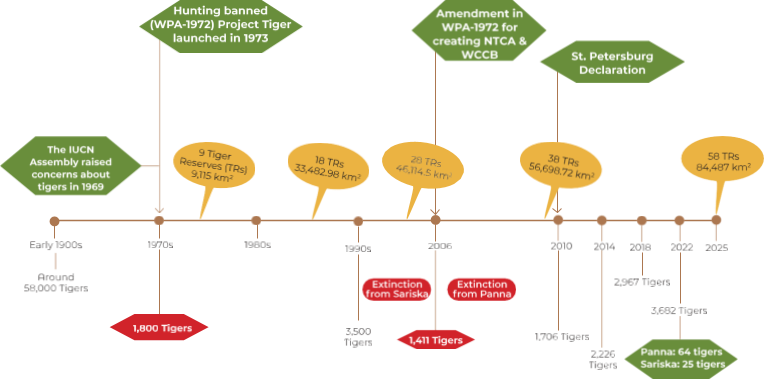
In the early 1900s, it is claimed that approximately 58,000 tigers roamed India’s forests, but by
the 1970s, hunting and habitat destruction resulted in almost eliminating the species. So, in
2022, when India counted its tigers, conservationists and policymakers had a reason to rejoice.
India now has 3,682 tigers. Tiger numbers have increased two-fold since 2010. This is a
remarkable achievement, considering that India has only 18% of global tiger habitat. India can
now be considered Tiger Land.
Way back in 1969, India hosted the 10th General Assembly of the International Union for
Conservation of Nature (IUCN) highlighting the vulnerability of tigers in South Asia. It expressed
its commitment to save the tiger. Within three years of the IUCN assembly, tiger hunting was
banned and within four years the Indian government launched Project Tiger (in 1973) to support
tiger recovery in the wild. The Indian Parliament amended the Wildlife (Protection) Act, 1972, in
2006 to create two statutory bodies: National Tiger Conservation Authority (NTCA) and Wildlife
Crime Control Bureau (WCCB). The Forest (Conservation) Act of 1980 reduced forest diversion,
and the Environmental (Protection) Act of 1986 regulated land use near forests–both crucial
legislations underpinning India’s tiger recovery. Such policies equipped the forest managers with
a more protectionist conservation approach, enhancing the governance mechanism that kept
the tiger at the centre of conservation.
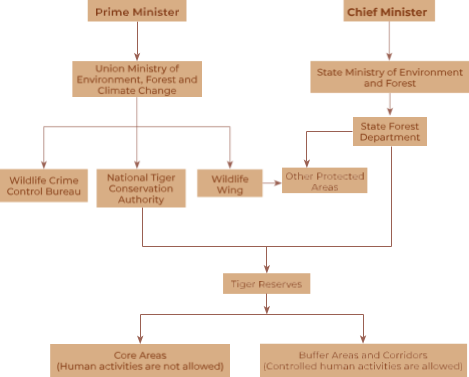
Fig: Governance Mechanism to Protect the tiger in india
Science-based Monitoring
The NTCA has been at the forefront of tiger conservation in India. Its mandate includes in-situ
protection initiatives, as well as science-based monitoring of tiger population and their habitats,
utilising the latest technological tools. The NTCA is also responsible for providing financial and
technical support to tiger reserves, creating an inviolate space for wildlife while ensuring
community development and international cooperation. To gauge the success of conservation
efforts and guide management inputs, NTCA uses the Management Effectiveness Evaluation
(MEE) framework. After every four years, independent experts conduct MEEs to evaluate how
well India’s tiger reserves are managed.
The WCCB, as an intelligence and enforcement agency, has combatted crimes involving tigers
and other endangered species. India has developed a robust technique to monitor wildlife crime,
utilising foot patrols by frontline forest staff while adhering to the Monitoring System for
Tigers’-Intensive Protection and Ecological Status (M-STrIPES) framework.
Further, scientific monitoring of tiger populations and incentive-driven voluntary relocation of
human settlements from tiger reserves were adopted to recover tiger populations in the wild.
These reforms transformed Project Tiger from a mere central government scheme into a
state-led commitment model with chief wildlife wardens (in the states), and field directors in tiger
reserves (in various districts) empowered to take decisions for protecting the tiger.
Fig: How tiger recovery Happened : A timeline
Currently, this governance structure (See Figure 1) is operationalised through a legally binding
Memorandum of Understanding among the three parties (i.e., NTCA, Chief Wildlife Wardens,
and Field Directors), and policies are developed and implemented through stakeholder
involvement. The state governments prepare Tiger Conservation Plans (TCPs) for each tiger
reserve with objectives to manage tiger reserves by providing site-specific habitat inputs to
support viable tiger and co-predator populations, and address the livelihood concerns of local
people. Management interventions in tiger reserves are codified through the TCP mandated
under the Wildlife (Protection) Act of 1972.
Under Project Tiger, states receive 60% budgetary assistance for expenditure on all non-recurring items, while the states offer the matching grant. In the Northeastern and Himalayan states, 90% of the budgetary assistance is provided by the government.
India’s polycentric governance model has enhanced the effectiveness of multiple organisations by clearly defining responsibilities and decision-making authority. In addition, it has enabled
several independent trial-and-error exercises in policymaking at the central, state, and tiger
reserve levels, fostering the system’s adaptability and reducing the risk of complete system
failure. For example, many situations involving small- and medium-sized common-pool
resources (e.g., the Tiger Conservation Foundation and the Eco-development Committees) are
best suited for decentralised, bottom-up institutional arrangements.
World’s Most Ambitious Project
Project Tiger is considered as one of the world’s most ambitious conservation projects. Estimates conducted every four years indicated that tiger numbers rose from approximately 1,800 to nearly 4,000 between 1972 and 1989. Between 1993 and 1995, the international trade
in tiger body parts emerged as a significant factor in the decline in tiger numbers. The All India
Tiger Estimation (AITE) survey methodology was developed and implemented in 2005 as India’s
new official tiger monitoring approach after the ambiguities of the previous ‘pugmark census’
method. So far, four periodic all India tiger estimation surveys (in 2006, 2010, 2014, 2018, and
2022) have taken place and the tiger population has increased on an average of 6% per year
since 2014.
India’s 1988 forest policy was a landmark as for the first time it recognised the development
importance of local people’s involvement in forest management to build resilient communities by
providing alternative livelihood opportunities while protecting forest resources. The principal aim
of the policy was to provide economic benefits from nature, encourage environmental
sustainability, and maintain ecological balance.
In a follow-up document issued in 1990, the government provided guidelines to all state
governments, instructing them to implement the Joint Forest Management (JFM) system by
transferring forest management and use rights to local communities.In the tiger reserves,
eco-development projects have also been implemented using a JFM approach to conserve tiger
habitats and provide livelihood opportunities to local communities.
To build resilience among local communities, the Indian government has prioritised resettlement
for households in high-tiger-occupancy areas to avoid conflicts with tigers. Conservation and
human development goals have been met by securing vast regions in tiger habitat through
community resettlement to better locations outside tiger reserves. The NTCA resettlement policy
requires families wishing to relocate (including each adult family member over 18 as a unit) from
a protected area to choose between receiving INR 1 million (US$15,517, with 1 US$ = INR 67 in
2018) or a land-based package. Benefits enjoyed by those who moved earlier have created a
positive feedback loop, encouraging other villages to relocate from tiger reserves
Since 1973, 257 villages with 25,007 families have been relocated from tiger habitats.
Meanwhile, 591 villages housing 64,801 families are still within the notified core zones of tiger
reserves. The acceptance of monetary compensation and signing of relocation agreements by
villagers living in tiger reserves is hailed by conservationists as a ‘win-win’ for both tigers and
communities.
Project Tiger has grown into a resilient, well-institutionalised programme. There has been a
strong political will in India that transcends party lines, resulting in policy and institutional
reforms as well as increased funding to support tiger conservation. Therefore, from a network of
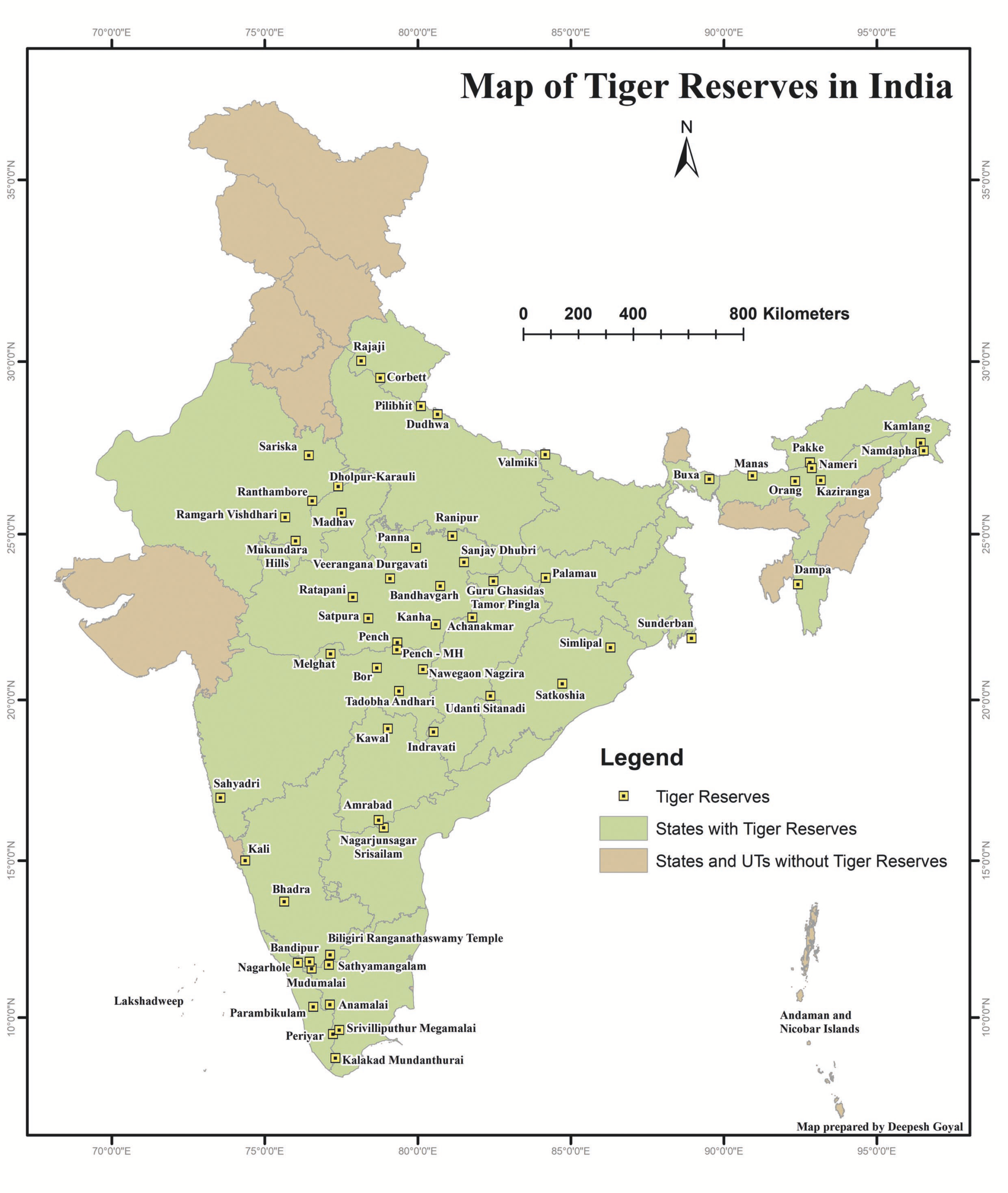
nine reserves covering a total area of 9,115 km² in 1973, Project Tiger now spans 58 reserves,
covering over 84,487 km² across the country (see map on Above).
India has also been collaborating with Nepal, Bhutan, Bangladesh, Russia, Myanmar, and China
on transboundary tiger conservation through bilateral agreements. This cooperation is crucial for
managing cross-border tiger populations, sharing wildlife crime intelligence, and maintaining
habitat connectivity. Additionally, India is supporting the tiger reintroduction programme in
Cambodia. Since the launch of Project Tiger, India has succeeded in reinvigorating institutional
governance and building more responsive mechanisms to ensure the tiger stays forever.
When Hunters are Protectors
India’s tiger population grew during the recovery programme’s early years, reaching more than
4,000 by the 1980s. However, new threats emerged – poaching and illegal trade. Tiger body
parts (bones, skin, and claws) were in demand for use in traditional Chinese medicine. Between
1994 and 1995, tigers in the renowned Ranthambore Tiger Reserve (in western Indian state of
Rajasthan) were reduced to a handful due to incessant poaching. Within a decade, further
shock came when in another Rajasthan tiger reserve, Sariska, no tigers were left. By 2009,
another reserve in central India, Panna, reported absence of tigers.
A tigress with her cub in Ranthambore Tiger Reserve. Photo : Aditya Dicky Singh
India appeared to be experiencing a national conservation crisis. It established a Tiger Task Force that aimed to reform institutional arrangements and governance. Policymakers and conservationists agreed that they needed a finger on the pulse of tiger populations and the existing ecosystems to preserve the species.
There were some key lessons in this debacle: There was need for a participatory philosophy of
institution-building. Also, there was need for improved Centre-state collaboration. Most critical
was the involvement of local communities who were more equipped to protect the tiger. The
tiger crisis motivated policymakers and conservationists to be more innovative – hunters can be
protectors too. In some tiger reserves (state of Arunachal Pradesh, Kerala) such a turnaround
has been witnessed.
S.P. Yadav is the Director General of the International Big Cat Alliance (IBCA). Dr Yadav, an avid wildlife enthusiast, is well known for his contribution towards conservation of big cats especially Tiger and Cheetah in India.
Dr Pramod holds a PhD from Clemson University, USA, and applies conservation social science to policy, governance, and sustainability research. He leads research and advocacy on sustainable livelihoods, wildlife management, biodiversity conservation, and socio-ecological systems. His work strengthens conservation efforts for seven big cat species across 96 range countries.